
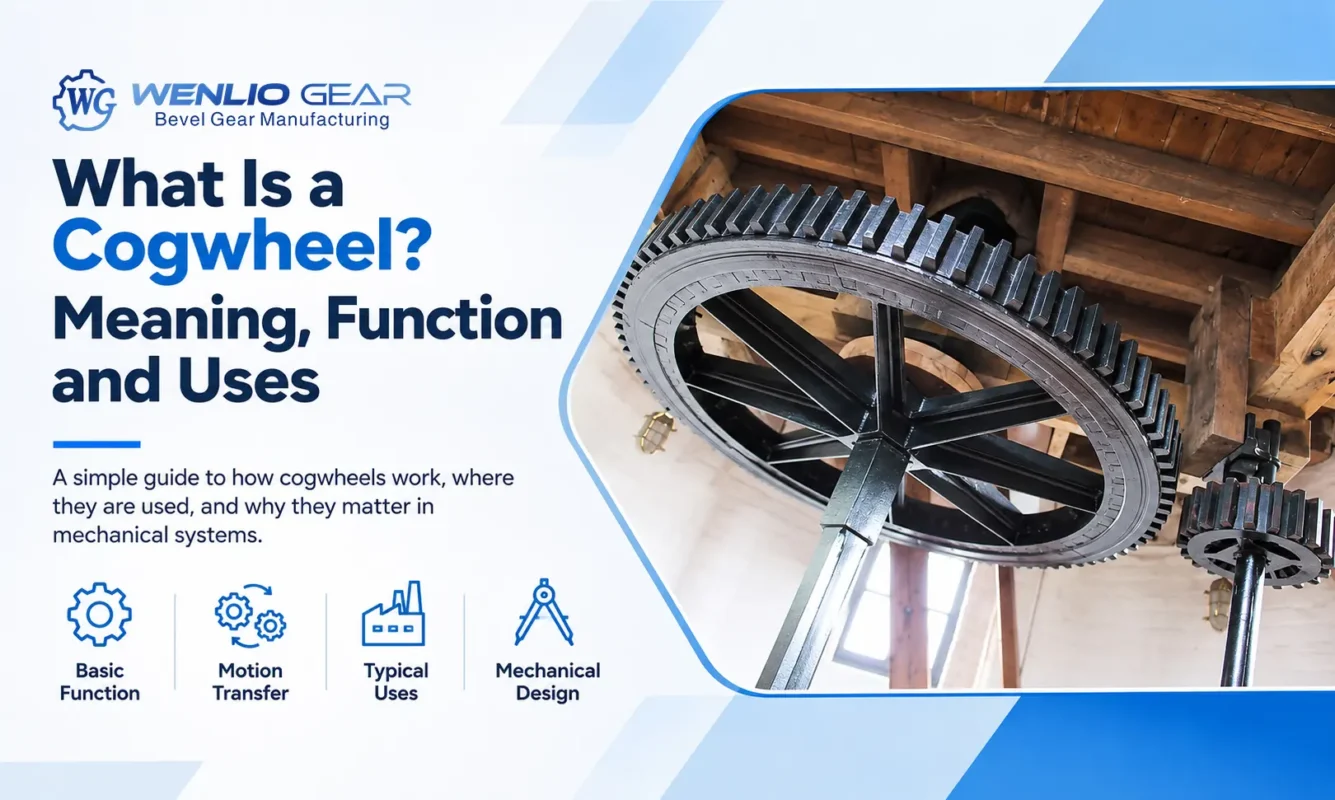
What is a cogwheel? A cogwheel is a toothed wheel that transfers rotational motion through engagement with another toothed component. It is used in mechanical systems to transmit torque, change rotational speed, and control the direction of movement. Although the term is often used interchangeably with gearwheel, it does not describe one specific gear design.
For engineers and buyers, understanding how cogwheels work and how different gear types are used can make component selection easier. As a precision gear manufacturer, Wenlio focuses on precision bevel gear manufacturing and customized transmission components for industrial applications. This guide covers cogwheel structure, working principles, industrial applications, and the key specifications to consider when sourcing custom gears.
What Is a Cogwheel?
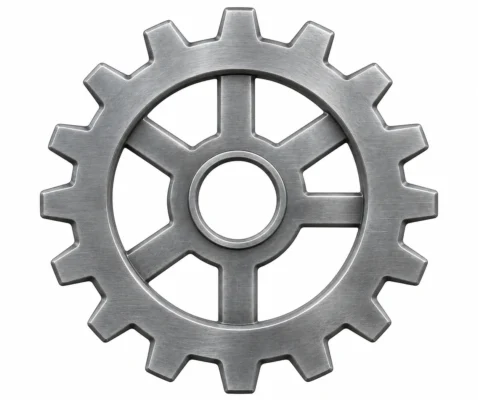
A cogwheel is a mechanical component with teeth arranged around its circumference. These teeth engage with another compatible toothed component to transfer rotational movement.
In everyday language, cogwheel and gearwheel generally refer to similar components. In engineering, however, more specific names are preferred because they describe the actual geometry and working arrangement.
A typical gear includes several important features:
- Gear teeth:Transfer force through engagement with another gear.
- Pitch circle:The theoretical reference circle used to define gear meshing.
- Gear body:Supports the tooth structure.
- Bore:Provides the mounting position for a shaft.
- Hub:Offers additional mounting support when required by the design.
The dimensions and geometry of these features determine whether a gear can fit and work correctly within a transmission system.
How Does a Cogwheel Work?
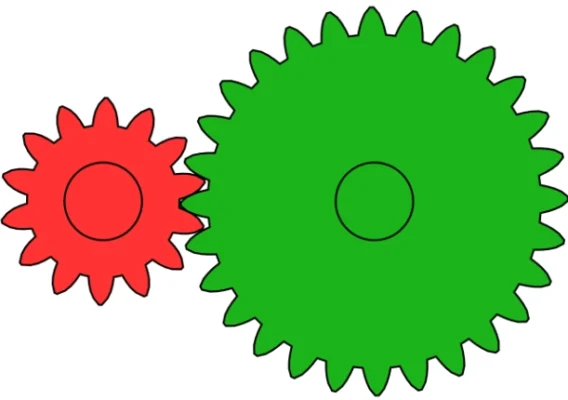
A cogwheel transfers motion when the teeth of two gears engage. The gear receiving input power is called the driving gear, while the other is the driven gear.
When the driving gear rotates, its teeth push against the mating teeth, causing the driven gear to rotate.
Speed and Torque
The number of teeth determines the speed relationship between two externally meshing gears.
For example:
| Parameter | Driving Gear | Driven Gear |
| Number of teeth | 20 | 60 |
| Input speed | 900 RPM | — |
| Output speed | — | 300 RPM |
| Gear ratio | 3:1 |
The driven gear rotates at one-third of the input speed. Under ideal conditions, its output torque is approximately three times the input torque.
Actual performance depends on friction, lubrication, gear geometry, and mechanical losses.
The gear ratio is therefore an important factor when selecting gears for equipment with specific speed and torque requirements.
Direction of Rotation
Two externally meshing gears rotate in opposite directions. Internal gear pairs generally rotate in the same direction.
The shaft arrangement also affects gear selection:
- Parallel shafts: Commonly use spur or helical gears.
- Intersecting shafts: Commonly use bevel gears.
- Offset or crossed shafts: May use hypoid or worm gear arrangements, depending on the design.
Cogwheel vs. Gearwheel vs. Sprocket: What Is the Difference?
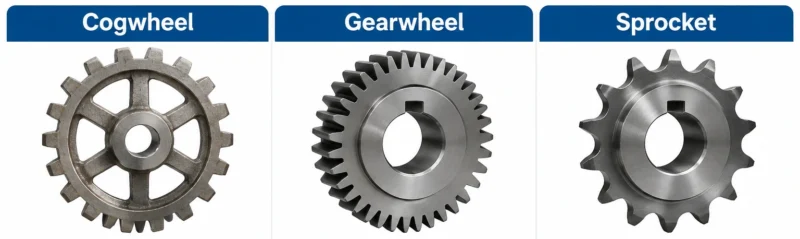
These three terms describe different aspects of mechanical components and should not be treated as interchangeable.
| Component | Main Structure | Motion Transmission |
| Cogwheel | General toothed wheel | Engages with another toothed component |
| Gearwheel | Gear designed for meshing | Direct gear-to-gear engagement |
| Sprocket | Specially shaped toothed wheel | Engages with a compatible chain |
The main difference is the contact mechanism. Conventional gears transmit motion through direct tooth engagement, while sprockets transfer movement through a chain.
For example, a roller chain sprocket must match the chain dimensions and pitch. Its teeth are not designed to mesh with a conventional spur gear.
When identifying a replacement component, buyers should provide the actual gear drawing or sample instead of relying only on the general term cogwheel.
What Are the Common Types of Gear Wheels?
Different gear designs serve different shaft arrangements, transmission ratios, and operating conditions.
Spur Gears
Spur gears have straight teeth parallel to the shaft axis. They are commonly used between parallel shafts and have a relatively simple structure.
Typical applications include machine tools, industrial equipment, and material handling systems.
Helical Gears
Helical gears have angled teeth that engage progressively across the face width. This arrangement allows more gradual load transfer and can provide smoother operation than comparable spur gears.
They are widely used in automotive transmissions and industrial machinery.
Bevel Gears
Bevel gears have teeth arranged on a conical surface and are commonly used between intersecting shafts.
Common designs include:
- Straight bevel gears
- Spiral bevel gears
- Zerol bevel gears
- Hypoid gears
- Crown bevel gears
- Miter bevel gears
Straight bevel gears have straight teeth, while spiral bevel gears use curved teeth. Hypoid gears have offset shaft axes, making their geometry different from conventional intersecting-shaft bevel gears.
The appropriate design depends on the shaft arrangement, transmission ratio, load, speed, and installation requirements.
Worm Gears
Worm gears consist of a screw-like worm and a mating worm wheel.
They are commonly used in compact transmission systems that require relatively large speed reductions. Their efficiency and operating characteristics depend on the lead angle, material, lubrication, and working conditions.
Internal Gears
Internal gears have teeth on the inside surface of a ring-shaped component.
They usually mesh with external pinions and are widely used in planetary gear systems and compact transmission arrangements.
Where Are Cogwheels Used?
Gears are essential in many industries because they provide a controlled method of transferring mechanical power.
| Industry | Typical Applications | Common Gear Types |
| Agricultural Machinery | Tractor drives, harvesters, power transmission | Bevel, spur, helical |
| Heavy Trucks | Differential and axle systems | Spiral bevel, hypoid |
| Construction Equipment | Drive systems and mechanical transmission | Bevel, spur, planetary |
| Electric Vehicles | Electric drive and differential systems | Helical, spur, bevel |
| Industrial Automation | Robotic joints, actuators, positioning systems | Spur, helical, bevel, worm |
| Power Tools | Compact right-angle drives | Straight bevel, spiral bevel |
For example, agricultural machinery often requires gears that can transmit power under changing loads and working conditions.
Heavy-duty vehicle applications may use bevel or hypoid gear sets to transfer power through differential systems.
Industrial automation equipment may use different gear arrangements according to positioning requirements, available space, and transmission ratios.
The application determines which gear geometry is suitable.
What Should Buyers Check When Selecting a Cogwheel?
The correct gear cannot be identified by outside diameter or tooth count alone. Buyers should confirm the complete geometry and operating requirements before requesting a quotation.
Gear Type and Dimensions
Start by identifying the gear type and its mating component.
Important parameters include:
- Module or diametral pitch (DP)
- Number of teeth
- Pressure angle
- Helix angle, where applicable
- Face width
- Pitch diameter
- Bore, keyway, or spline dimensions
The gear module defines tooth size and is an important factor in determining whether two metric gears can mesh correctly.
The pressure angle also affects tooth geometry and force transmission. Gears with matching module but incompatible pressure angles should not be assumed to form a suitable mating pair.
Material and Heat Treatment
Material selection depends on the expected load, operating environment, and required service conditions.
Important considerations include material strength, surface hardness, core properties, and wear resistance.
The heat treatment process should be considered together with the material and final manufacturing route, because heat treatment can affect both mechanical properties and dimensional stability.
Gear Accuracy and Inspection
Gear accuracy is another important factor, particularly for equipment requiring controlled meshing and dimensional compatibility.
Depending on the application, inspection may include:
- Tooth profile and lead deviations
- Pitch errors
- Radial and axial runout
- Hardness
- Surface roughness
For bevel gear sets, tooth contact pattern and backlash should also be considered.
The mounting distance can affect the installed meshing condition, so it should be confirmed when the design requires specific assembly positions.
Operating Conditions
The working environment also affects gear selection.
Before starting a custom gear project, consider:
- Operating speed and torque
- Working load and duty cycle
- Lubrication conditions
- Operating temperature
- Dust, moisture, and other environmental factors
These details help establish suitable manufacturing and inspection requirements.
How to Start a Custom Gear Project
For OEM and replacement gear projects, a complete technical review helps reduce misunderstandings before sampling and batch production.
Buyers can prepare:
- 2D drawings or 3D models
- Existing gear samples or clear product photos
- Gear type and key dimensions
- Material and heat treatment requirements
- Accuracy and inspection requirements
- Estimated order quantity
- Equipment application and operating conditions
If a complete drawing is unavailable, an existing sample and its mating component can provide a starting point for technical evaluation.
Wenlio focuses on precision bevel gear manufacturing and customized transmission components for agricultural machinery, heavy trucks, construction equipment, electric vehicles, and industrial automation.
As a precision gear manufacturer and custom gear supplier, Wenlio works with OEM and industrial customers on product requirements, manufacturing coordination, and customized gear projects.
FAQ About Cogwheels
Q1. Is a cogwheel a specific type of gear?
No. Cogwheel is a general term for a toothed wheel. Specific gear types include spur gears, helical gears, bevel gears, worm gears, and internal gears.
Q2. Can two gears with the same number of teeth mesh together?
Not necessarily. Their module or diametral pitch, pressure angle, tooth profile, and other relevant geometric parameters must also be compatible.
Q3. Does the number of teeth determine gear speed?
The tooth-count relationship determines the theoretical speed ratio of a simple gear pair. The actual output speed also depends on the input speed and transmission arrangement.
Q4. Can spur gears replace helical gears?
Not automatically. They have different tooth geometries and operating characteristics. Shaft arrangement, load, speed, axial force, and installation requirements should be reviewed before considering a replacement.
Q5. What information is needed to manufacture a custom gear?
A manufacturer normally needs drawings or samples, gear dimensions, module or DP, tooth count, pressure angle, material, heat treatment, accuracy requirements, and order quantity. Application and operating conditions are also important.
Conclusion
A cogwheel is a general term for a toothed wheel used to transfer rotational motion. Different gear designs provide different solutions for speed control, torque transmission, and shaft arrangements. For engineers and buyers, selecting the correct gear requires more than identifying its basic type. Tooth geometry, material, accuracy, installation conditions, and operating requirements must all be considered.
Wenlio supports custom precision gear projects with a focus on bevel gears and industrial transmission components for agricultural machinery, heavy trucks, construction equipment, electric vehicles, and industrial automation. If you are developing a new product or sourcing replacement gears, share your drawings, samples, and technical requirements with our team. Contact Wenlio to discuss your custom gear requirements and request a quotation.
