
Blogs, Bevel Gear
What Are the Different Types of Bevel Gears?
Aug
Introduction
Bevel gears come in several forms, and the differences go beyond appearance. Tooth geometry, shaft position, gear ratio, and mating arrangement all affect how a gear set meshes and where it can be used.
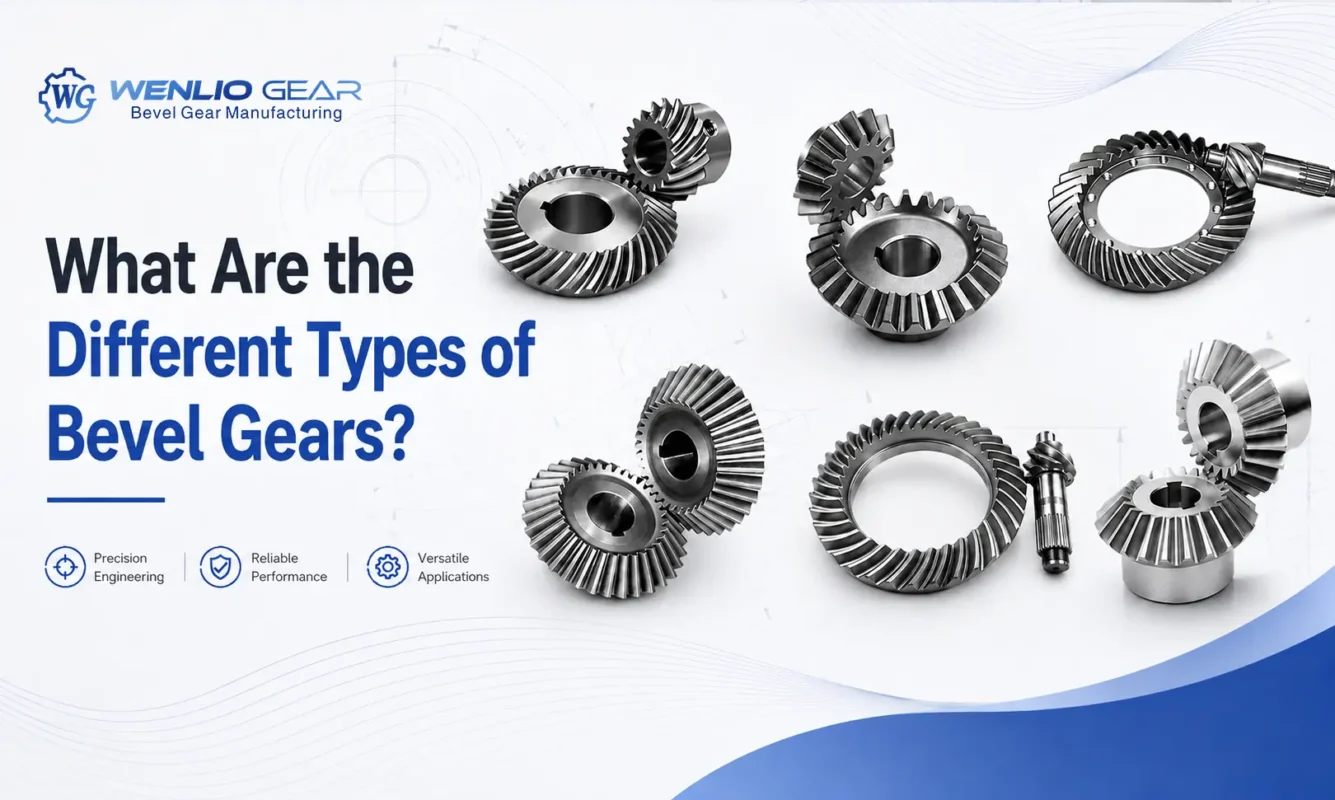
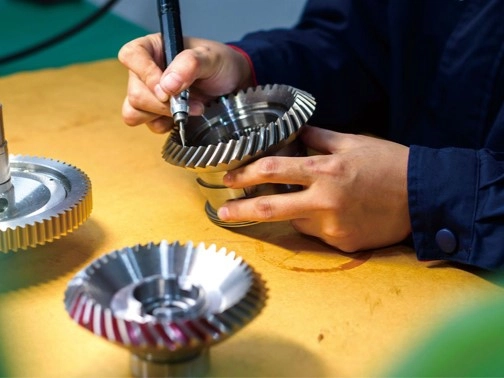
Straight, spiral, hypoid, Zerol, crown, and miter gears are all found in Wenlio’s bevel gear range, but they are selected for different reasons. Some are distinguished mainly by tooth geometry, while others are defined more by shaft layout or gear ratio. Understanding these differences makes it easier to review a new design or replacement project.
Quick Answer: What Are the Main Types of Bevel Gears?
The main types of bevel gears include straight, spiral, hypoid, Zerol, crown, and miter gears. Straight, spiral, and Zerol gears mainly differ in tooth geometry. Hypoid gears use offset shafts, crown gears have a specialized face-style arrangement, and miter gears are mainly defined by a 1:1 ratio.
What Are the Six Common Types of Bevel Gears?
1. Straight Bevel Gears
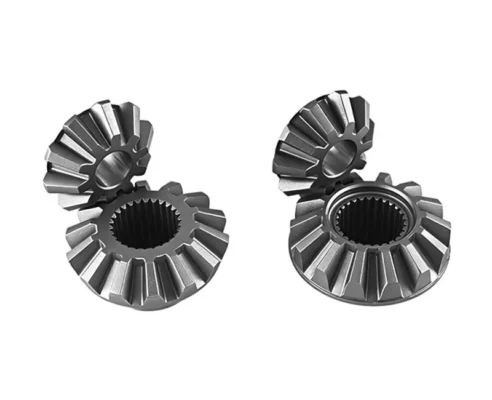
Straight bevel gears have straight teeth cut along a conical surface. They are normally used between intersecting shafts, with 90 degrees being a common shaft angle.
Their relatively simple tooth geometry can make manufacturing and inspection more straightforward than with curved-tooth designs. Straight bevel gears are often used in low- to medium-speed drives where noise is not the main design concern.
At higher speeds, the more direct tooth engagement may make noise and vibration more noticeable, so operating conditions still need to be reviewed before selecting this type.
Wenlio supplies custom straight bevel gears based on drawings, mating information, and application conditions.
2. Spiral Bevel Gears
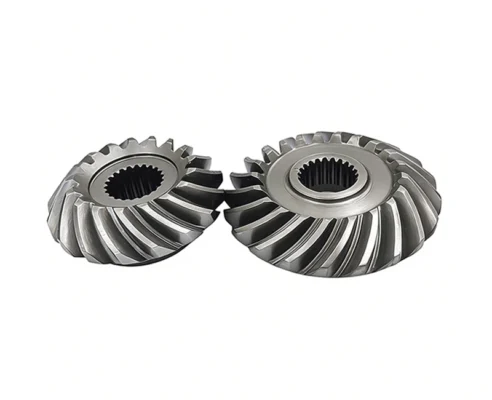
Spiral bevel gears use curved teeth that enter and leave mesh progressively. This produces more continuous engagement than a comparable straight-tooth arrangement and can support smoother operation.
Spiral bevel gears often suit higher-speed applications, tighter noise requirements, or smoother power transmission. However, their curved tooth surfaces make the gear pair more sensitive to geometry and installation, so the design must account for spiral hand, mounting distance, backlash, contact pattern, bearing arrangement, and mating gear data. In addition, spiral bevel gears generate axial thrust, making the bearing arrangement an important part of the overall gear-pair design.
For a more detailed comparison, see Straight Bevel Gear vs Spiral Bevel Gear.
3. Hypoid Gears
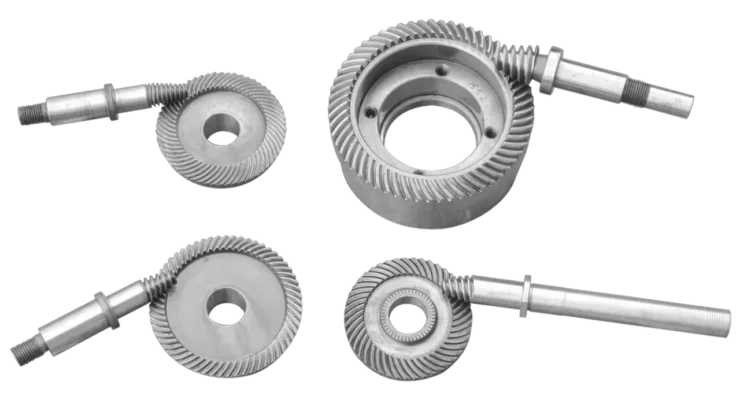
Hypoid gears resemble spiral bevel gears, but their shaft axes are offset rather than intersecting.
This offset allows the input and output shafts to be positioned at different levels, which can help when a conventional intersecting-shaft arrangement does not fit the available space.
Hypoid tooth contact also involves more sliding between the mating surfaces. Lubrication, tooth contact, surface condition, mounting position, and operating temperature therefore become important design and inspection considerations.
Although hypoid gears differ geometrically from conventional intersecting-shaft bevel gears, they are commonly discussed alongside bevel gears in transmission design and manufacturing.
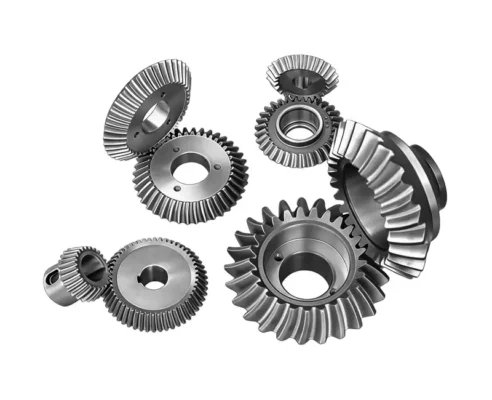
4. Zerol Bevel Gears
Zerol bevel gears have curved teeth with a mean spiral angle of zero. They operate between intersecting shafts, but their tooth geometry differs from both conventional straight and spiral bevel gears.
A zero mean spiral angle does not eliminate axial forces. Actual force conditions still depend on tooth geometry, pressure angle, rotation direction, load, and the mating gear. For projects using this tooth form, engineers should review the shaft angle, bearing arrangement, rotation direction, mating data, and gear geometry together.
Wenlio supplies custom Zerol bevel gears for projects with specific right-angle transmission and mating requirements.
5. Crown Bevel Gears
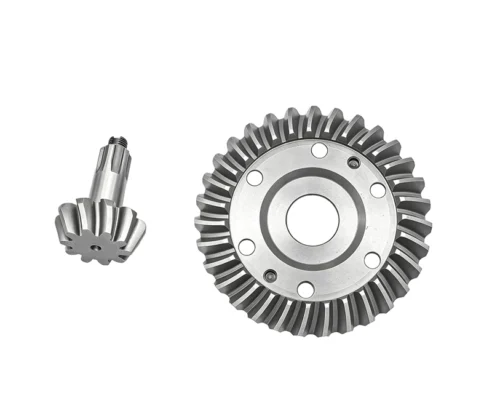
Evaluate crown bevel gears together with their mating gear because they use a specialized face-style arrangement. Designers may choose them for compact right-angle layouts or applications where the mating arrangement differs from a conventional bevel gear pair.
For a crown gear project, information about the mating gear, shaft relationship, available installation space, mounting references, and required contact condition is especially useful.
This becomes even more important in replacement projects. Copying one worn crown gear without checking the mating part may not reproduce the original meshing relationship.
6. Miter Bevel Gears
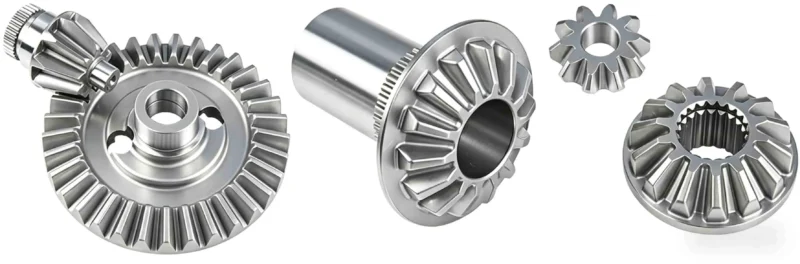
Miter gears are mainly defined by their 1:1 ratio. The two mating gears normally have the same number of teeth and are used to change the direction of rotation without changing speed.
“Miter” does not describe one specific tooth form. Miter gears may have straight or curved teeth, so both straight miter and spiral miter arrangements are possible.
A miter gear inquiry should therefore include more than the ratio. The review should cover tooth form, shaft angle, mating relationship, backlash, and contact requirements.
How Do the Different Types of Bevel Gears Compare?
| Type | Main Geometry | Shaft Relationship | Key Characteristic | Common Use |
| Straight | Straight teeth | Intersecting | Direct engagement, simpler geometry | Simple right-angle drives |
| Spiral | Curved teeth | Intersecting | Progressive engagement | Smoother or higher-speed drives |
| Hypoid | Curved teeth | Offset, non-intersecting | Allows shaft offset with more sliding | Compact offset layouts |
| Zerol | Curved teeth, zero mean spiral angle | Intersecting | Specialized curved-tooth geometry | Specific right-angle drives |
| Crown | Specialized face-style arrangement | Depends on mating layout | Specialized mating geometry | Compact or unusual layouts |
| Miter | Straight or curved teeth | Usually intersecting | 1:1 ratio | Direction change without speed change |
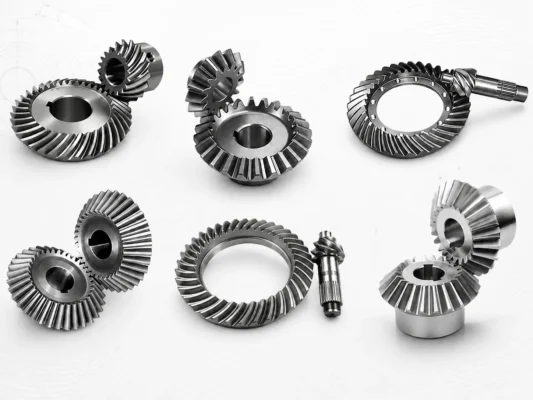
This comparison provides a useful starting point rather than a fixed selection rule. In general, a straight bevel gear may suit a simple right-angle drive, while engineers often choose spiral bevel gears when smoother operation matters. By contrast, hypoid gears suit designs that need shaft offset, while miter gears work well when the ratio must remain 1:1. However, the final choice still depends on load, speed, installation space, bearing conditions, lubrication, noise requirements, and the mating arrangement.
What Should Buyers Check Before Selecting a Bevel Gear Type?
A few basic project details can narrow the options quickly.
| Check First | Why It Matters |
| Shaft relationship | Shows whether the shafts intersect or require an offset |
| Gear ratio | Indicates whether a 1:1 miter arrangement is relevant |
| Speed and torque | Affect gear size, tooth form, material, and process requirements |
| Start-stop or reversing motion | Makes backlash and tooth contact more important |
| Installation space | Limits the gear, shaft, housing, and bearing arrangement |
| Existing mating gear | Important for replacement and matching projects |
For replacement gears, tooth count and ratio alone are rarely enough. Shaft angle, mounting position, mating gear geometry, and existing contact condition may all affect whether the replacement will mesh correctly.
Can Different Types of Bevel Gears Be Interchanged?
In most cases, no. A matching tooth count or gear ratio does not make two bevel gears interchangeable.
For example:
- A straight bevel gear normally cannot directly replace a spiral bevel gear.
- Do not replace a hypoid gear with an intersecting-shaft bevel gear simply because the ratio matches.
- Likewise, two 1:1 bevel gears do not automatically form a correct miter pair.
Therefore, a replacement review should also check tooth geometry, shaft angle, mounting distance, mating gear data, spiral hand, backlash, and contact pattern.
For existing equipment, it is usually better to review the complete gear pair rather than copy a single worn component.
What Information Should Buyers Provide for Custom Bevel Gears?
For an initial review, useful project information includes:
- Drawing or 3D model;
- Existing gear type, if known;
- Tooth count and ratio;
- Shaft angle or shaft offset;
- Mating gear information;
- Speed and torque;
- Direction of rotation;
- Duty cycle;
- Material and heat-treatment requirements;
- Backlash and contact requirements.
If you do not have a complete drawing, start the review with a sample, clear photographs, and installation information. However, do not assume that measurements from a worn part represent the original design values.
How Does Wenlio Review a Bevel Gear Project?
Each bevel gear project starts with the mating relationship and actual application conditions, not the gear type alone.The basic review normally covers:
- Drawing, sample, and available gear data;
- Shaft angle, offset, ratio, and mating relationship;
- Speed, torque, rotation direction, and duty cycle;
- Material, heat treatment, machining, and inspection requirements;
- Prototype and inspection approval before production.
For both drawing-based and sample-based custom gear projects, Wenlio adjusts the review route according to the technical information available.
FAQ
What Type of Bevel Gear Is Best for High-Speed Applications?
Spiral bevel gears are often considered for higher-speed applications because of their progressive tooth engagement. The final choice still depends on load, noise requirements, bearing support, lubrication, and the complete gear-pair design.
Can Miter Gears Have Spiral Teeth?
Yes. Miter describes a 1:1 bevel gear ratio rather than one specific tooth form. A miter gear pair may use straight or curved teeth.
Do Hypoid Gear Shafts Intersect?
No. Hypoid gears use offset, non-intersecting shaft axes. This is one of the main differences between hypoid gears and conventional bevel gears.
Can a Bevel Gear Be Made from a Worn Sample?
A worn sample can provide useful starting information, but measured dimensions may no longer represent the original design. The mating gear, installation position, and wear condition should also be reviewed when possible.
Can Bevel Gears With the Same Ratio Be Interchanged?
Not necessarily. Matching ratio and tooth count do not confirm compatibility. Tooth geometry, shaft angle, mounting distance, spiral hand, backlash, and mating conditions also need to match.
Conclusion
Straight, spiral, hypoid, Zerol, crown, and miter bevel gears suit different transmission layouts. The right choice depends on tooth geometry, shaft position, gear ratio, installation space, and the mating gear—not just the product name.
For a new design or replacement project, send Wenlio the drawing, sample photos, mating gear information, shaft layout, ratio, speed, torque, and quantity. Contact Wenlio to review the project information and determine a suitable bevel gear type and manufacturing route.

Pingback: Bevel Gear Supplier: What to Check Before an RFQ? - wenlio.com
Pingback: How to Choose the Right Bevel Gear Manufacturer - wenlio.com