
Blogs, Bevel Gear
Bevel Gear Mounting Distance: Why It Matters
Aug
Introduction
A bevel gear pair can meet its drawing dimensions and still perform differently after assembly. A shifted contact pattern, changed backlash, increased noise, or higher operating temperature does not always indicate a manufacturing error. In such cases, also check the installed gear position.
Bevel gear mounting distance is one of the dimensions that defines this relationship. In Wenlio bevel gear projects, it is reviewed together with shaft angle, backlash, bearing position, mating gear geometry, and assembly references rather than as an isolated dimension.
Quick Answer: What Is Bevel Gear Mounting Distance?
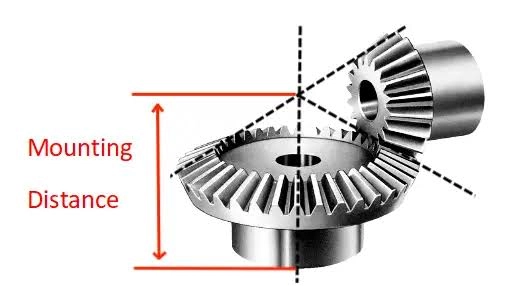
Bevel gear mounting distance defines the axial position of a bevel gear relative to a specified assembly reference. Correct positioning helps the gear pair achieve the intended backlash and tooth contact. If the installed position changes, the contact pattern and backlash may change as well, so mounting distance should be evaluated together with the gear pair and assembly conditions.
What Does Mounting Distance Mean on a Bevel Gear Drawing?
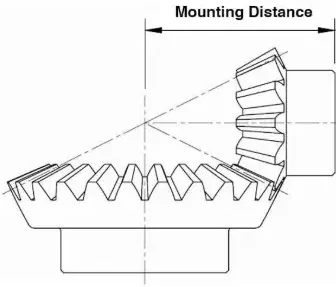
Mounting distance is not simply the distance between two gears. Instead, it serves as a reference dimension that locates a bevel gear axially in the assembly.
On the drawing, link this dimension to a clearly defined datum, seating surface, or other assembly reference. Because different gear designs may specify mounting distance differently, the value alone is not enough. Also confirm where the dimension starts and which installation reference defines it.
For a bevel gear pair, confirm the following items together:
- Pinion position;
- Gear position;
- Shaft angle;
- Hypoid offset, where applicable;
- Bearing and housing references.
Bevel gears work as a mating pair, so their installed relationship matters just as much as the individual dimensions of each component.
Why Does Bevel Gear Mounting Distance Matter?
1. It Can Change the Contact Pattern
Bevel gear teeth should contact within a designed area under the specified mounting conditions. If the pinion or gear moves axially from its intended position, the tooth contact can shift. Even after restoring backlash to an acceptable range, the contact pattern may not return to its intended position.
This is why a contact-pattern check should consider more than:
“Is the backlash within tolerance?”
It should also consider:
“At what mounting position were this backlash and contact pattern achieved?”
2. It Can Change Backlash
Mounting distance and backlash are different parameters, but they influence each other.
Moving a bevel gear axially changes the way the mating teeth engage and can alter the measured clearance between the tooth flanks. This is why bevel gear backlash should not be evaluated separately from the mounting condition.
If backlash is noticeably higher or lower than expected after assembly, tooth thickness is not the only item to check. Gear position and housing references may also be involved.
3. It Can Affect Noise and Operating Temperature
A change in mounting position can move the tooth contact away from the intended area.
If contact becomes concentrated or backlash changes significantly, the gear pair may develop additional noise, vibration, or higher operating temperature.
These symptoms do not prove that mounting distance is the only cause. Gear geometry, bearing condition, shaft alignment, lubrication, and actual load can produce similar problems.
Mounting distance is therefore best treated as part of the overall assembly check rather than as a stand-alone diagnosis.
4. It Can Change Load Distribution
A bevel gear pair is designed to carry load over an intended area of the tooth surface.
If the installed position shifts and the contact becomes localized, the effective load-carrying area can also change.
For gear pairs that are sensitive to tooth contact, dimensional inspection alone may not fully represent the assembled condition. Mounting position, backlash, and contact pattern should be reviewed together.
What Happens When the Mounting Distance Is Incorrect?
| Observed Condition | What Should Be Checked |
| Contact pattern shifts | Pinion and gear axial positions |
| Backlash is too high or too low | Mounting position, tooth thickness, and mating setup |
| Gear pair becomes noisy after assembly | Contact pattern, backlash, alignment, and bearings |
| Contact becomes concentrated | Mounting position and mating geometry |
| Operating temperature increases | Contact, backlash, lubrication, load, and mounting setup |
These conditions suggest checking the assembly relationship, but they do not point to mounting distance as the only possible cause. Also review the gear pair, bearings, housing, lubrication, and operating load together.
Is Mounting Distance the Same as Backlash?
No. Mounting distance determines the gear position in the assembly, while backlash describes the clearance between mating tooth flanks.
The two are related, but they are not interchangeable.
For example, moving a gear axially during assembly may bring backlash back into the target range. If the actual gear position still differs from the intended mounting condition, however, the contact pattern may remain shifted.
In other words:
Correct backlash does not automatically mean correct mounting.
Why Is Mounting Distance Important for Matched Bevel Gear Sets?
For a matched bevel gear set, mounting distance cannot be considered from one gear alone.
This is especially important for spiral bevel, hypoid, or other gear sets that have been checked or matched as a pair. Their final meshing condition depends on several related factors:
- Gear and pinion geometry;
- Mounting position;
- Shaft angle;
- Offset;
- Backlash;
- Contact condition.
A matched bevel gear set still needs to be installed according to the intended mounting references. Having two individually acceptable gears does not mean their installed positions can be changed freely.
What Should Buyers Check on a Drawing or RFQ?
Mounting requirements are easier to control when the relevant information is clear during drawing review and quotation.
| Item to Confirm | Why It Matters |
| Pinion mounting position | Defines the axial position of the pinion |
| Gear mounting position | Defines the position of the mating gear |
| Datum / reference surface | Shows where the mounting dimension is measured from |
| Shaft angle | Affects the designed mating relationship |
| Hypoid offset | Required for offset-axis gear sets |
| Backlash requirement | Should correspond to the intended assembly condition |
| Contact pattern requirement | Helps verify the mating condition |
| Mating gear data | Important for replacement and matched sets |
Not every project shows all of these as separate dimensions. The key is to give the gear supplier enough information to understand where the gears fit, what they mate with, and which references define their positions.
Can Mounting Distance Be Determined From a Worn Gear Sample?
A worn gear alone is usually not enough to reliably reconstruct the original mounting condition.
An old part can still provide useful information such as:
- Tooth count;
- Bore;
- Outside dimensions;
- Some tooth and structural features.
Mounting distance, however, may also depend on the original housing, bearing position, mating gear, and assembly references.
Wear can also change the current tooth-contact condition and backlash. For this reason, measurements taken from an old part should not automatically be treated as the original design values.
For sample-based projects, it is helpful to provide:
gear + mating gear + housing or assembly photos + available mounting references.
This gives a clearer basis for reviewing the original gear relationship.
How Does Wenlio Review Mounting Distance in a Bevel Gear Project?
Review mounting distance as part of the complete gear-pair relationship rather than as an isolated dimension. The basic review normally covers:
- Drawing, datums, and mounting references;
- Axial positions of the pinion and gear;
- Shaft angle, offset, and mating relationship;
- Backlash and contact requirements;
- Mounting conditions used for prototype or matched-pair inspection.
For replacement projects with incomplete drawings, the mating gear, housing references, and available assembly information can also help establish the intended mounting condition. Wenlio adjusts the review route for drawing-based and sample-based custom gear projects according to the technical information available.
FAQ
What Is Mounting Distance in a Bevel Gear?
Mounting distance defines the axial position of a bevel gear relative to a specified assembly reference. It helps establish the intended mating position and is closely related to backlash and tooth contact.
Does Mounting Distance Affect Bevel Gear Backlash?
Yes. Moving a bevel gear axially can change the measured backlash, so check the mounting position and backlash together during assembly.
Can Incorrect Mounting Distance Cause Gear Noise?
It can be one contributing factor. A change in mounting position can alter tooth contact and backlash, which may increase noise. Bearing condition, alignment, gear geometry, lubrication, and load should also be checked.
Is Mounting Distance Important for Hypoid Gears?
Yes. In a hypoid gear set, consider the gear and pinion positions together with shaft offset and the complete mating geometry.
Can Mounting Distance Be Measured From an Old Gear?
An old gear can provide useful dimensional information, but it is usually not enough to reconstruct the original mounting relationship on its own. Therefore, also review the mating gear, housing, bearing arrangement, and available assembly references whenever possible.
Conclusion
Bevel gear mounting distance helps define the installed relationship of a gear pair and can affect both contact pattern and backlash. If noise, abnormal contact, backlash changes, or higher temperature appear after assembly, check the mounting position, shaft relationship, bearings, lubrication, and mating gear together.
For new or replacement projects, drawings, mating gear information, mounting references, shaft angle, backlash, and contact requirements provide a better basis for review. These details can be included when you contact Wenlio for project evaluation.

Pingback: Spiral bevel gear rotation direction: left vs right hand - wenlio.com
Pingback: When Should a Bevel Gear Pair Be Inspected as a Matched Set? - wenlio.com
Pingback: Spiral Bevel Gear Noise: What Should You Check First? - wenlio.com
Pingback: What Causes Pitting on Bevel Gear Teeth? - Wenlio