
Blogs, Custom Gear
How to Choose a Precision Gear Manufacturer for Custom Gears
Aug
Introduction
When sourcing custom gears, the ability to make the part is only one part of supplier selection. Material, heat treatment, finishing, accuracy, inspection, and assembly conditions can all affect the final result.
A reliable precision gear manufacturer should be able to review the available drawing or sample, identify key technical points, and define a suitable manufacturing and inspection plan before production. At Wenlio, this review forms the basis for custom gear projects.
How Do You Choose a Precision Gear Manufacturer?
Choose a precision gear manufacturer by checking its drawing review, process planning, inspection capability, and production consistency. For matched gears, also confirm mating geometry, backlash, mounting conditions, and contact requirements.
What Should You Look for in a Precision Gear Manufacturer?
A manufacturer suitable for custom gear work should not quote only from tooth count, module, outside diameter, and quantity.
Before placing an order, check whether the supplier can clearly address:
- Drawing completeness and technical data;
- Material and heat treatment;
- Manufacturing methods for the required accuracy;
- Inspection standards and acceptance criteria;
- Mating or assembly conditions;
- Prototype approval and production control.
The earlier these points are aligned, the easier it is to keep quotation, prototyping, production, and final acceptance based on the same specifications.
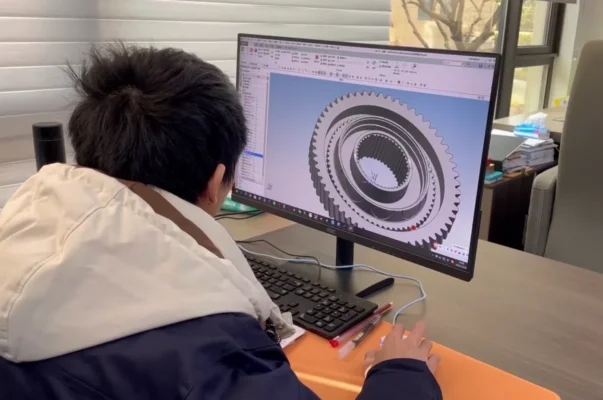
Can the Manufacturer Review the Drawing Before Quoting?
Drawing review is one of the clearest ways to evaluate a supplier’s technical capability.
Beyond tooth count and basic dimensions, a manufacturer should review details such as tooth geometry, material grade, heat treatment, accuracy grade, critical tolerances, mating gear information, and inspection scope.
If dimensions are missing, standards conflict, or assembly conditions are unclear, these issues should ideally be raised before quotation.
Otherwise, a gear may be manufactured according to the available data but still require rework because the buyer and supplier interpreted the design differently.
For projects with only a 3D model, worn sample, or incomplete technical data, Wenlio can start with an initial review as part of its custom gear manufacturing process, then identify any dimensions or mating details that still need confirmation.
Does the Manufacturing Route Match the Final Requirements?
The manufacturing route should be determined by material, heat treatment, accuracy, and production quantity.
Depending on the gear and its specifications, the process may involve hobbing, shaping, milling, gear grinding, lapping, or hard finishing.
For example, if a gear must maintain relatively high accuracy after heat treatment, simply confirming that the supplier can hob the teeth is not enough. The process should also consider heat-treatment distortion, machining allowance, and whether additional finishing will be required.
Instead of asking only:
What machines do you have?
A more useful question is:
How will this gear be manufactured, and why is this process suitable for the drawing?
A supplier that can explain the relationship between the selected process and the final specification provides a clearer basis for production.
How Should Heat Treatment and Final Accuracy Be Reviewed?
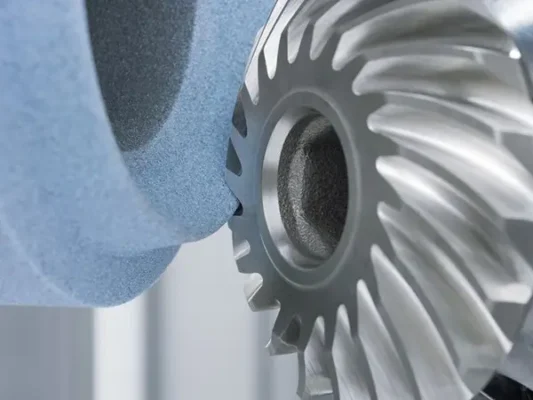
Heat treatment should be considered together with the finishing operations that follow it.
For carburized, hardened, or otherwise heat-treated gears, the review may cover material grade, heat-treatment process, surface hardness, core hardness or case depth where applicable, distortion control, post-heat-treatment finishing, and final inspection.
A quotation that simply says “heat treatment included” does not fully define the delivered condition.
If heat treatment may affect tooth profile, lead, or critical dimensions, the manufacturing plan should account for distortion and any required finishing before production begins.
When evaluating a supplier, it is therefore useful to understand how gear heat treatment connects to the required final accuracy.
Does the Inspection Plan Match Your Gear Project?
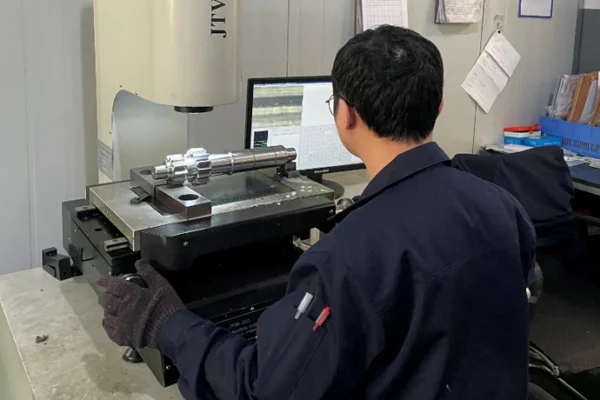
A good inspection plan focuses on the characteristics that matter to the drawing and application.
Depending on the gear, inspection may include critical dimensions, tooth thickness, runout, tooth profile and lead, accuracy grade, hardness, backlash, or contact pattern.
The focus varies by gear type.
A standard spur gear may mainly require dimensional checks, tooth thickness, and runout. A high-precision bevel gear pair may also require mating and contact-pattern checks.
For this reason, buyers should clarify before production:
What will be inspected, and what will be used as the acceptance criteria?
This is more effective than adding inspection requirements after the gears have already been manufactured.
Does the Project Require Mating-Gear Control?
For gears that operate as a pair, acceptable individual parts do not automatically guarantee acceptable assembly performance.
Bevel gears, hypoid gears, miter gears, and some replacement gear projects may also require control of mating gear geometry, shaft angle, mounting distance, spiral hand, backlash, contact pattern, and pair identification.
These factors influence how the gears mesh after assembly.
For matched bevel gear sets, buyers should therefore look beyond individual dimensions and understand how the supplier handles mating, installation, and contact checks.
How Are Prototype Requirements Carried Into Production?
An approved prototype is only the first step. The next challenge is maintaining the same basis during production.
Once a project moves into a batch order, buyers should check whether the approved material remains unchanged, key processes stay consistent, inspection methods continue to follow the approved plan, and critical dimensions use the same acceptance criteria.
So instead of asking only:
“Can you make a prototype?”
It is also useful to ask:
“How will the approved prototype conditions be controlled in production?”
This gives buyers a clearer view of how the supplier manages repeatability after sample approval.
How Do You Compare Two Precision Gear Manufacturers?
When comparing two precision gear manufacturers, first check whether both quotations cover the same technical and commercial scope.
| Compare | What to Check |
| Drawing review | Whether missing or unclear information is identified |
| Material | Exact material grade or approved equivalent |
| Heat treatment | Process, hardness, and case depth |
| Gear finishing | Tooth finishing before and after heat treatment |
| Accuracy | Standard and acceptance grade |
| Inspection | Exact report scope |
| Mating control | Whether backlash, contact, or pairing is required |
| Production control | How approved prototype conditions are carried into production |
If these items differ, two quotations based on the same drawing may still represent different manufacturing and delivery scopes.
Is the Lowest Gear Quote Always the Best Choice?
Not necessarily, but a lower price does not automatically indicate a problem either.
The more useful question is:
Are both suppliers quoting the same technical and commercial scope?
For example, one quotation may include heat treatment, post-heat-treatment finishing, and a gear inspection report, while another simply states “heat treatment included.”
In that situation, comparing unit prices directly would be premature.
Likewise, a higher quotation does not automatically mean higher quality. Material, process route, accuracy, inspection, quantity, tooling, lead time, packaging, and delivery scope should first be aligned.
Price becomes much easier to compare after that.
What Should Buyers Send Before Requesting a Custom Gear Quote?
A complete RFQ reduces technical assumptions during quotation.
| Information | Why It Helps |
| 2D drawing / 3D model | Defines geometry and critical dimensions |
| Gear type | Indicates the basic manufacturing approach |
| Material & heat treatment | Defines the material and performance basis |
| Accuracy grade | Sets manufacturing and inspection targets |
| Mating gear data | Supports matched or replacement gear evaluation |
| Application | Provides load, speed, and operating context |
| Quantity | Distinguishes prototype, small-batch, and production needs |
| Inspection requirements | Establishes the acceptance basis |
If a complete drawing is unavailable, buyers can also provide a worn part, clear photos, key dimensions, OEM information, or mating components.
However, dimensions measured from a worn gear may not represent the original design values. For replacement gears, current measurements should therefore be considered together with assembly and mating information.
How Does Wenlio Review a Custom Gear Project?
Wenlio typically begins an initial custom gear review with five steps:
- Review the drawing, 3D model, or sample information;
- Check gear geometry and mating relationships;
- Review material, heat treatment, and accuracy;
- Define the main manufacturing and inspection methods;
- Clarify prototype approval and subsequent production conditions.
The focus depends on the project.
A replacement gear may require more information about the worn part, mating component, and installation. A complete made-to-drawing gear can usually proceed directly from drawing tolerances, material specifications, and acceptance criteria.

FAQ
What Should I Ask a Precision Gear Manufacturer Before Ordering?
Ask about drawing review, material, heat treatment, manufacturing process, accuracy, inspection, and production control. For matched gears, also confirm mating, backlash, and contact requirements.
Can a Gear Manufacturer Quote Without a Complete Drawing?
Yes, but quotation accuracy depends on the available information. Samples, photos, key dimensions, mating gear data, and application details can help with the initial review.
Should I Choose a Manufacturer Based on Gear Accuracy Grade Alone?
No. Accuracy grade should be considered together with material, heat treatment, finishing, inspection, and operating conditions.
What Inspection Reports Should a Custom Gear Manufacturer Provide?
It depends on the drawing and acceptance criteria. Common records include dimensions, tooth thickness, runout, tooth profile, lead, hardness, backlash, and contact pattern.
How Can I Compare Quotes From Different Gear Manufacturers?
First compare material, heat treatment, finishing, accuracy, inspection, quantity, tooling, lead time, and delivery scope. Then compare price.
Conclusion
Choosing a precision gear manufacturer is ultimately about determining whether the supplier can turn the drawing into a manufacturable, inspectable, and repeatable production plan.
For a new custom gear or replacement gear project, prepare the available drawing, 3D model, sample photos, mating gear information, material, accuracy, quantity, and inspection requirements. You can then contact Wenlio for an initial technical review.

Pingback: What is a driving gear in a precision gear system? - wenlio.com