
Blogs, Bevel Gear
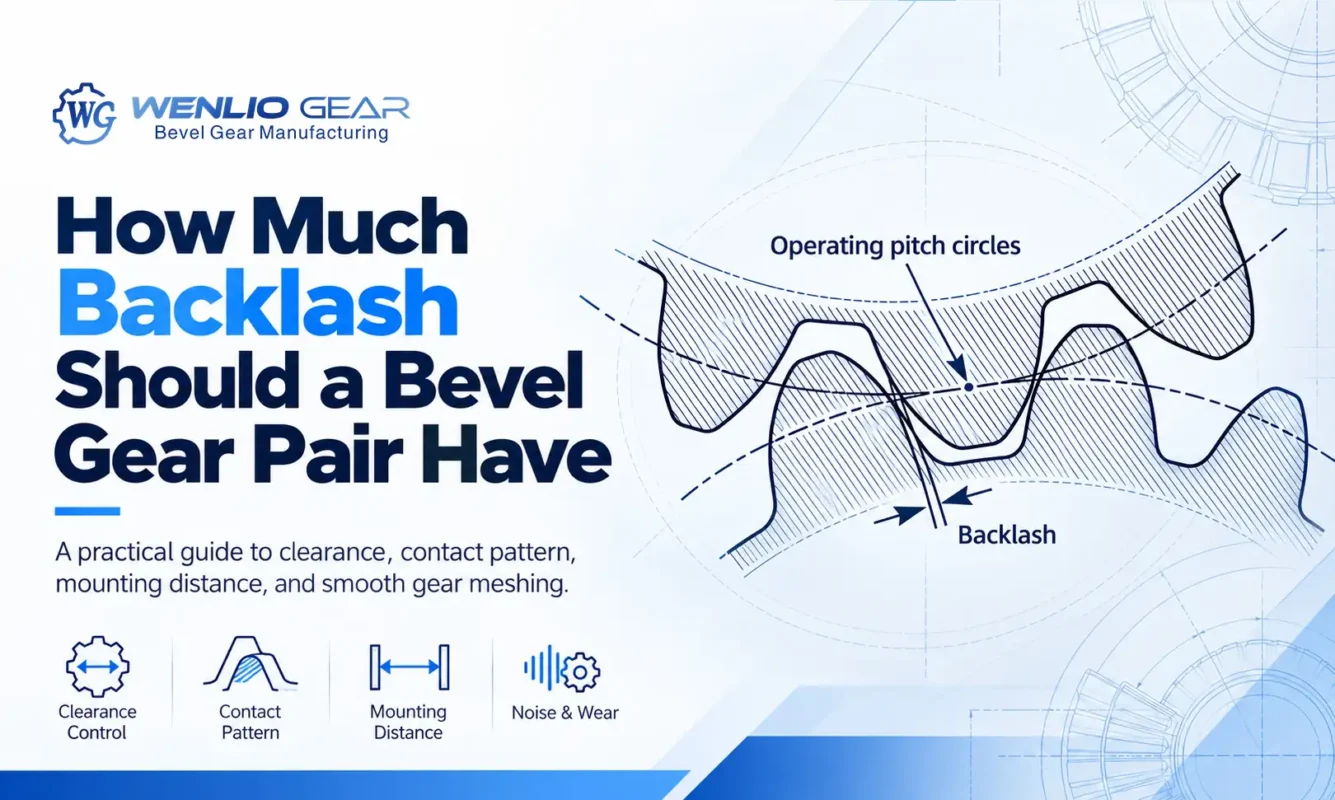
How Much Backlash Should a Bevel Gear Pair Have
Oct
Backlash doesn’t get a lot of respect. On paper it’s one more tolerance on the drawing, easy to skim past.
In the real world it decides whether a gearbox runs quiet or noisy, runs cool or hot, holds position or rattles every time it reverses. We’ve lost count of the pairs that looked perfect as machined parts and then acted up the moment they were installed. Most of those jobs traced back to backlash.
So before you ask us for a number, ask yourself what the pair actually has to do. Clearance that works in one gearbox can be dead wrong in another. It depends on the drawing, the mounting distance, the accuracy grade, the load, the speed, the lubrication, and the conditions the unit runs in.
Wenlio makes bevel gears and handles custom gear projects. This guide is our way of walking buyers through backlash the same way we talk about it in the shop, so you know what matters and what to send us when you’re ready for a quote.
Start With the Gear Pair, Not a Standard Number
Every so often a buyer calls and asks point blank: what’s the standard backlash for a bevel pair? There isn’t one. The value that’s right for you comes out of the design. Module, tooth count, accuracy grade, mounting distance, running temperature, lubrication, and what the gearbox is supposed to do all have a vote.
Get it too tight and the teeth fight each other. Heat, wear, sometimes binding. Get it too loose and you hear knocking, feel the reverse impact, watch the positioning drift.
Neither number is bad on its own. It’s bad only when it doesn’t match the application. That’s why we ask for drawings, the mating gear, the gearbox layout, and how the unit is used before we’ll even guess at a clearance.
What Backlash Actually Means in the Pair
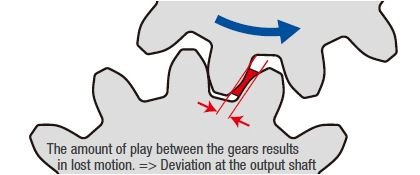
Backlash, put simply, is the gap between the non-working tooth faces of two meshing gears. A lot of people hear the word “gap” and assume sloppy work. It’s not, and it’s not something to grind away either. Almost every gear system runs with some backlash on purpose.
Why? Because a meshing pair needs room. Room for the oil film, room for the metal to grow when it warms up, room for the tolerances that stack up during machining, room for the fact that no two assemblies ever go together identically.
Take that room away and the flanks jam against each other. Then you get heat, you get wear, you get drag.
And no, smaller backlash doesn’t mean a better gear. We hear that one constantly. Precision gears still run with clearance. The difference is their clearance gets held in a tight band, and the contact behaves predictably.
One thing worth repeating: a bevel gear is half of a pair. The clearance you finally get depends on mounting distance, shaft angle, bearings, housing accuracy, and how the pair gets set up. Judge one gear alone and you’ll miss the real picture.
Why Backlash Changes the Whole Assembly
Backlash has its fingers in a lot of pies. Noise, tooth contact, heat, wear, and how the drive behaves in reverse. Bevel gears feel it more than most because their contact pattern is touchy. It moves with assembly position.
Set the clearance wrong and the contact walks off its ideal spot. Drift it toward the tip, root, toe, or heel, and you’re giving up gear life and stability.
Loose, and the gears knock on load change or direction reversal. Tight, and the mesh complains. Whine, heat, friction. If the machine reverses all day, backlash is also what decides how much dead travel you feel before the output catches up.
When Backlash Is Too Tight or Too Loose
The point isn’t whether backlash exists. It’s whether the amount fits the gearbox. In the field it usually shows up like this:
Table 1. Common backlash conditions and their risks
| Backlash condition | Possible symptoms | Common risks |
| Too small | Tight mesh, heat, higher noise | Tooth scuffing, poor lubrication, higher bearing load |
| Too large | Reverse impact, knocking noise, loose transmission | Positioning error, impact wear, unstable running |
| Uneven backlash | Tight and loose spots during rotation | Wrong mounting distance, shaft misalignment, housing or bearing issues |
| Correct backlash | Smooth rotation and stable contact pattern | Better lubrication, thermal allowance, and stable transmission |
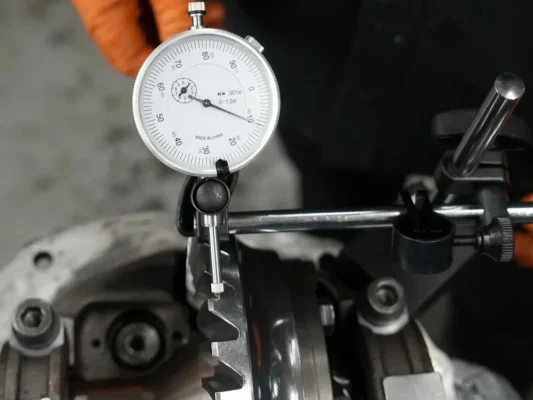
Hand-feel tells you something, but not everything. On a job that matters, look at the drawing requirement, the contact pattern, and the assembly condition as one package.
What Changes the Right Backlash Value?
Nobody picks a backlash value out of the air. It shifts with size, accuracy, mounting, and duty. Change any of those and the right number moves with it.
Gear Size, Accuracy, and Tooth Thickness
Module, tooth count, tooth thickness. All of them feed the requirement. It would be silly to hold a small-module instrument gear and a big-module heavy-duty gear to the same clearance.
Accuracy matters because it drives tooth thickness variation, profile error, lead error, and how evenly the teeth share the mesh. Tighter accuracy usually wants tighter backlash. Tighter, mind you. Not zero.
Mounting Distance and Alignment
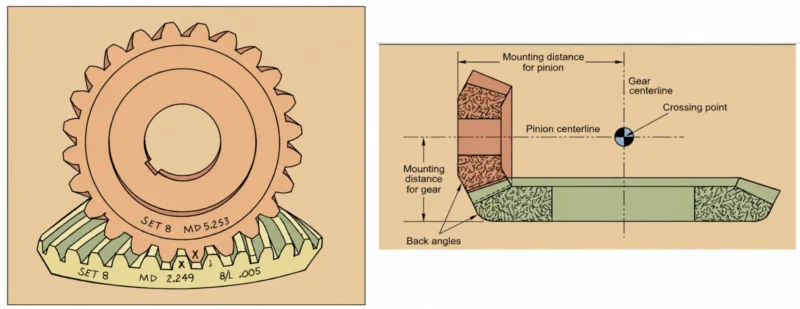
Check mounting distance before you check almost anything else. You can machine the gears perfectly and still get the wrong contact and the wrong backlash if the mounting distance is off.
Bevel gears move power between intersecting shafts. Shaft angle, bearing position, and housing accuracy all get baked into the final mesh. Poor alignment can even make the backlash change as the pair rotates. Tight in one spot, loose in another.
Load, Speed, Temperature, and Lubrication
What you worry about changes with speed. Fast gears get picked apart over noise, heat, and smooth running. Heavy-duty gears get picked apart over tooth strength, lubrication, and contact. Temperature deserves its own look, since thermal expansion moves the gears relative to the housing.
Lubrication is in the mix too. Oil bath, splash, or something else. Each one protects the tooth surfaces, controls temperature, and steadies the running a little differently.
Why Zero Backlash Is Usually the Wrong Target
“Can you give us zero backlash?” We get this. Usually it comes from buyers who think tighter equals better. For a standard bevel pair, zero is the wrong target.
Teeth need that clearance for oil and for thermal growth. Remove it and the mesh loads up the moment things heat up. Heat and wear follow.
Shrinking backlash also costs you before the gears ever reach the box. Tighter machining tolerances, stricter assembly control, a stiffer housing. If the application doesn’t need it, you’re spending more and risking the assembly for nothing.
Now, there are real exceptions. Positioning systems. Automation drives that can’t stand lost motion. But those get solved at the system level. Gear design, preload, bearing support, housing accuracy, inspection method. No gear, on its own, fixes the whole backlash story.
What to Prepare Before Asking for a Quote
How fast we can answer “yes,” “no,” or “we need more” mostly depends on what lands in our inbox. For backlash, the list below covers the usual needs:
Table 2. Information buyers should prepare before requesting a quote
| Information type | What to provide |
| Drawing | Backlash, tooth thickness, tolerances, mounting distance, and inspection requirements |
| Mating gear | Mating gear data, photos, or sample |
| Gearbox layout | Input/output shaft position, shaft angle, and mounting structure |
| Gear data | Tooth count, module, pressure angle, spiral angle, and hand direction |
| Application | Equipment type, load, speed, and whether the gearbox reverses frequently |
| Sample condition | Wear position, service time, noise, or failure symptoms |
| Inspection needs | Contact pattern, profile, lead, runout, hardness, or related reports |
No full drawing? Then send the old sample, photos of the mating gear, photos of the gearbox installation, and a plain description of the problem. That’s usually enough for us to say whether we can measure the sample and what else we’d want.
Can an Old Sample Help Set Backlash?
An old sample is a starting point, not a guarantee. After a long service life the tooth surfaces wear, the tooth thickness shrinks, and the contact pattern moves.
Copy those worn dimensions straight into a new gear and you’ll likely get too much clearance, or poor contact with the mate.
For replacements, send the mating gear if you possibly can. Bevel gears are defined by the pair. One worn gear can’t show the true meshing condition. If the old gear has noise, pitting, broken teeth, or odd wear, tell us about it. That tells us whether the problem lives in backlash, contact, material, heat treatment, or lubrication.
Mistakes That Usually Cause Backlash Problems
Most backlash problems we see never started on the machine. They started at the quoting stage, with incomplete information.
We tend to see the same mistakes repeatedly. A buyer asks for a specific backlash value but provides no drawing, mounting distance, or operating conditions. Sometimes the mating gear is left out of the evaluation, or the gearbox layout gets overlooked while all the attention stays on the gear itself. Another common mistake is treating any backlash as a defect, or assuming a badly worn sample should simply be copied as-is.
Backlash is a design and assembly matter. It’s not automatically a defect. What counts is whether the clearance matches the design, holds steady tooth to tooth, and fits the real application.
How Wenlio Reviews a Bevel Gear Pair
When a bevel pair project lands on our desk, we look at three things. The gear. The mating relationship. The application.
With drawings, we start on parameters, mounting distance, tolerances, and inspection requirements. Without drawings, samples and clear photos give us a first read.
Backlash and contact hang on the mating gear, so replacement and repair jobs usually need that gear’s data. Load, speed, temperature, lubrication, and reverse frequency all steer how we review the clearance.
Depending on the job, we focus on profile, lead, runout, hardness, contact pattern, or pairing marks. Whatever gives you a solid inspection basis.
FAQ
How much backlash should a bevel gear pair have?
There’s no single number that fits every pair. It follows the drawing, module, accuracy, mounting distance, load, speed, and application. Best to go by the design requirement, or have the supplier review it and confirm before production.
Is zero backlash good for bevel gears?
Not for a standard pair, no. Gears need clearance for oil, thermal expansion, and assembly tolerances. Cut it too far and you’ll get heat, wear, and drag.
Can backlash cause bevel gear noise?
It sure can. Too much and you get knocking and reverse impact. Too little and the mesh runs tight, usually whining or running hot. Noise can also trace to contact, mounting distance, accuracy, or lubrication, so check them together.
Can you remake a bevel gear from an old sample and control backlash?
Yes. We do this often. Send the sample, clear photos, the mating gear, and gearbox details. We measure the sample, look at the wear, confirm key dimensions, and review the application before we decide whether the new gear needs adjusting.
What should I send before ordering a bevel gear pair?
Drawings, mating gear info, gearbox structure, gear parameters, material and heat treatment requirements, application conditions, and inspection requirements. On a replacement job, add wear photos and failure symptoms.
Conclusion
Here’s the short version. Bevel gear backlash isn’t a number you lift from another project. It has to fit the gear design, the gearbox structure, the application, and your inspection setup. Get it right, and the pair holds stable contact, keeps room for oil, and runs reliably.
Need a bevel gear pair, or one remade from an old sample? Contact us the drawings, sample photos, mating gear info, and gearbox details. We’ll go over backlash, contact, material, heat treatment, and inspection before we quote or cut any metal.
