
Blogs, Bevel Gear
Bevel Gears in Right-Angle Gearboxes: Buyer’s Guide
Oct
Many types of machinery need to transfer power from one direction to another, such as converting horizontal input into vertical output. For this type of 90-degree transmission, bevel gears are a very common solution. However, needing a right-angle drive does not always mean that bevel gears are the only option.
In real projects, engineers and buyers also need to consider shaft arrangement, gear ratio, speed, torque, noise, installation space, and maintenance conditions. For custom or replacement projects, Wenlio usually looks at the complete transmission conditions, not just the dimensions of a single gear. The correct gear type must match the gearbox structure and actual working conditions.
Are bevel gears suitable for right-angle gearboxes?
If the input shaft and output shaft need to intersect at an angle close to 90 degrees, and the project requires good transmission efficiency, load capacity, and compact structure, bevel gears are usually worth considering first.
Straight bevel gears are more suitable for relatively simple structures and lower-speed transmission. Spiral bevel gears are more commonly used in gearboxes with higher speed, heavier load, or higher requirements for smooth operation.
However, if the two shafts do not truly intersect and have a certain offset, standard bevel gears may not be the most suitable choice. In this case, hypoid gears or other right-angle transmission solutions should also be evaluated.
Why are bevel gears often used in right-angle gearboxes?
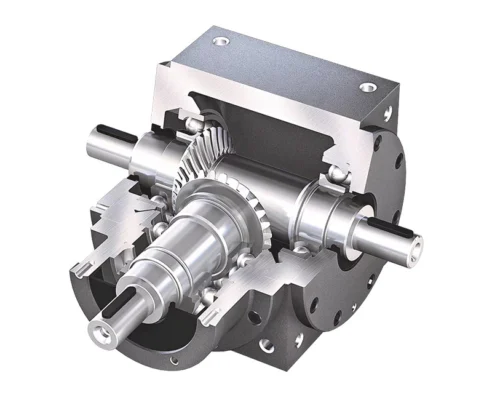
The main feature of bevel gears is that they can change the direction of power transmission between intersecting shafts.
In a typical right-angle gearbox, the two shafts are usually arranged at 90 degrees. A bevel gear set can complete this direction change in a relatively compact space while maintaining a direct mechanical transmission path.
Common advantages include:
- Changing the input and output direction;
- Supporting different gear ratios;
- Suitable for medium to high-load mechanical transmission;
- Spiral bevel gears can provide smoother meshing;
- The structure can be designed to be relatively compact;
- Suitable for continuous rotary transmission.
One important point should be noted:
A 90-degree transmission does not mean the gear ratio must be 1:1.
Only a miter gear set with the same number of teeth on both gears is typically used for 1:1 right-angle transmission. Standard bevel gear pairs can achieve speed reduction or speed increase through different tooth counts.
Which applications are more suitable for bevel gears?
Bevel gears are suitable for mechanical systems that need to both change direction and transmit relatively high torque. Common applications include:
Agricultural machinery
Some agricultural equipment needs to transfer power from the main drive shaft to working components in different directions.
In this type of structure, the right-angle gearbox changes the power direction, while the bevel gears carry the main transmission load.
Industrial machinery
Right-angle gearboxes are often seen in conveying equipment, packaging machinery, machine tool accessories, and various mechanical transmission systems.
If the equipment runs continuously and requires stable transmission performance, spiral bevel gears are often more worth considering than simple straight bevel gears.
Construction machinery
Construction equipment usually places greater emphasis on torque, shock load, and long-term durability.
For this type of project, gear selection should not be based only on gear size. Material, heat treatment, tooth surface condition, and bearing support should also be considered together.
Automotive and vehicle transmission
Differentials and some transmission mechanisms also widely use bevel gears or hypoid gear sets.
However, these systems usually have stricter requirements for installation position, tooth contact, and matched pairs.
Straight bevel gears or spiral bevel gears?
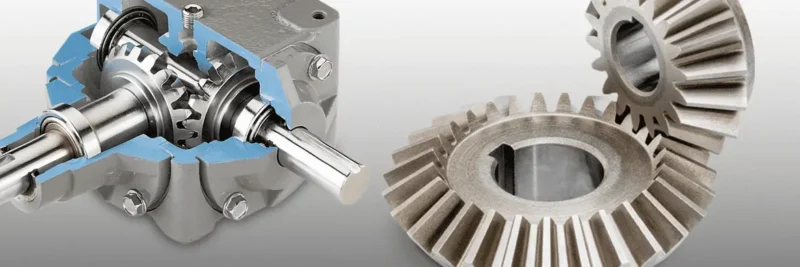
This is one of the most common selection questions in right-angle gearbox projects.
| Item | Straight Bevel Gear | Spiral Bevel Gear |
| Tooth line | Straight | Curved / spiral |
| Meshing style | Relatively direct | Progressive meshing |
| Running smoothness | General | Usually better |
| High-speed application | Relatively limited | More suitable |
| Noise control | Suitable when noise requirements are not high | Better for low-noise requirements |
| Manufacturing complexity | Lower | Higher |
| Common applications | Low speed, medium load | Medium to high speed, higher load |
If the gearbox runs at a relatively low speed and the project prioritizes a simple structure and lower manufacturing cost, straight bevel gears may be a suitable choice.
For equipment that runs continuously, operates at higher speeds, or requires better control of vibration and noise, engineers should also evaluate spiral bevel gears.
Still, speed alone should not determine the final choice. Load, installation space, target service life, and gearbox rigidity also play important roles.
What information should buyers confirm before selection?
When sourcing bevel gears, the most common issue is not whether the gear can be manufactured, but whether the technical conditions have been fully confirmed.
Before requesting a quote, buyers should prepare at least the following information:
| Item | Why it matters |
| Angle between input and output shafts | Determines whether it is a typical bevel gear transmission |
| Whether the two shafts truly intersect | Helps decide whether a standard bevel gear or hypoid gear may be needed |
| Gear ratio | Determines the tooth count relationship between the two gears |
| Input speed | Affects gear type, accuracy, and noise requirements |
| Input / output torque | Affects size, material, and heat treatment |
| Working time | Determines whether the system is continuous or intermittent |
| Shock load | Affects tooth surface and tooth root design |
| Allowed noise level | Affects the choice between straight and spiral teeth |
| Installation space | Affects gear outside diameter and shaft arrangement |
| Backlash requirement | Affects assembly and gear accuracy |
| Material and heat treatment | Affects wear resistance and fatigue life |
| Quantity | Affects process route and quotation |
If it is a new gearbox design, it is best to provide the complete assembly drawing.
If it is a replacement gear project, in addition to the old gear sample, it is also better to provide the mating gear, installation position, and equipment information.
For projects that still need early engineering review, Wenlio’s custom gear R&D and design support can help buyers organize drawings, gear parameters, application conditions, and manufacturing feasibility before production.
Why is tooth contact so important?
For bevel gears, qualified dimensions do not always mean the gear set will work properly after assembly.
Mounting distance, bearing condition, gear position, and tooth surface geometry all affect the actual contact pattern. If you want to understand the working logic behind bevel gear meshing, you can also read Wenlio’s guide on how bevel gears work and contact pattern basics.
If the contact area is clearly biased toward the tooth top, tooth root, or tooth end, local load may increase. After long-term operation, this may lead to:
- Increased noise;
- Local wear;
- Pitting;
- Temperature rise;
- Reduced tooth surface life.
Therefore, for bevel gear sets with higher requirements, buyers should pay attention not only to dimensional reports, but also to the matched condition and tooth contact pattern.
This is especially important in spiral bevel gear projects.
Does installation accuracy affect bevel gear performance?
Yes, and the impact is significant.
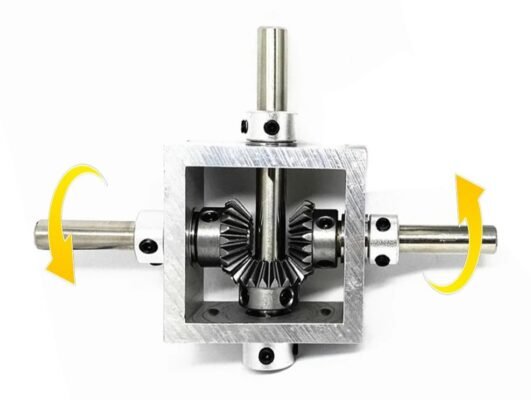
Bevel gears depend more on correct spatial positioning than ordinary parallel-shaft cylindrical gears.
Several common influencing factors include:
Mounting distance
Changes in the axial position of the gear will change the actual meshing position.
Bearing clearance
If the bearing support is not rigid enough or has obvious clearance, the gear position may change under load.
Backlash
Too little backlash may cause temperature rise and higher running resistance. Too much backlash may increase impact and noise.
Housing rigidity
If the gearbox housing deforms significantly under load, the gear meshing condition may also change.
Therefore, when sourcing custom gears, it is better not to separate the gear completely from the gearbox.
Bevel gear or worm gear: how should buyers choose?
Both bevel gears and worm gears can be used for right-angle transmission, but their selection logic is different.
| Item | Bevel Gear | Worm Gear |
| Shaft arrangement | Usually intersecting | Usually non-intersecting |
| Transmission efficiency | Usually higher | More affected by sliding friction |
| Large single-stage reduction ratio | General | Easier to achieve |
| High-speed running | Spiral bevel gears are more suitable | Temperature rise should be considered |
| Heat generation | Relatively lower | Thermal management is more important |
| Structure | Compact | Can also be compact |
| Typical use | Efficient right-angle power transmission | Right-angle transmission with large reduction ratio |
If the project focuses more on efficiency, higher speed, and power transmission, bevel gears are usually more worth considering.
If a relatively large reduction ratio is required in a single stage, worm gears may have more advantages.
However, the final choice should still be based on actual working conditions.
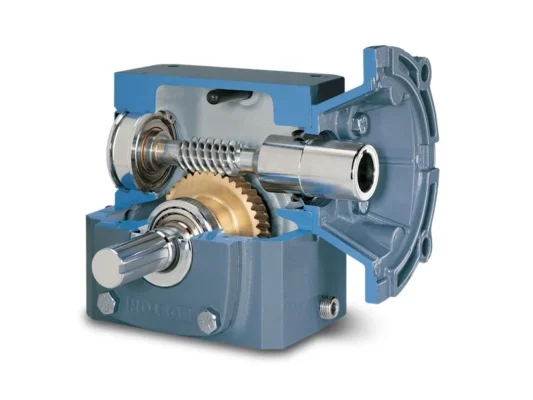
Material and Heat Treatment Should Be Considered Together
Many purchasing projects start with this question:
“What material should be used for this bevel gear?”
In fact, material is only one variable in the whole design.
For high-load gearboxes, a common approach is to choose suitable alloy steel and combine it with carburizing, quenching, or other heat treatment methods to improve tooth surface wear resistance.
However, if the gear design, tooth contact, or installation condition is unreasonable, simply increasing hardness cannot solve all problems.
Buyers should confirm these factors together:
Material + heat treatment + tooth surface accuracy + contact condition + lubrication + installation conditions.
Looking at these factors together is closer to the real working condition.
What should buyers prepare before sending an inquiry?
If you are sourcing new bevel gears for right-angle gearboxes, it is recommended to provide:
- 2D or 3D drawings;
- Information for both mating gears;
- Tooth count;
- Module or DP;
- Pressure angle;
- Spiral direction and related tooth geometry parameters;
- Shaft angle;
- Mounting distance;
- Material;
- Heat treatment;
- Hardness;
- Accuracy requirements;
- Backlash;
- Input speed;
- Torque;
- Application equipment;
- Annual demand or order quantity;
- Inspection requirements.
The more complete the information is, the easier it is for the supplier to evaluate the manufacturing plan.
It can also reduce repeated technical revisions after quotation.
How does Wenlio evaluate bevel gear projects for right-angle gearboxes?
For bevel gear projects, Wenlio prefers to understand the actual working environment of the gear before looking only at part dimensions.
If the customer provides complete drawings, we can review them to confirm the manufacturing and inspection requirements.For a replacement project, we can further evaluate the old part, mating part, and application information before confirming the technical requirements.
For right-angle gearboxes, technical communication usually focuses on confirming:
- Gear type;
- Matched relationship;
- Shaft arrangement;
- Material and heat treatment;
- Accuracy requirements;
- Contact condition;
- Inspection requirements.
This can reduce repeated confirmation caused by insufficient information.
If you are comparing gear types, manufacturing routes, or inspection requirements, you can also browse Wenlio’s gear guides and technical resources for more related articles.
FAQ
Do all 90-degree gearboxes use bevel gears?
No. Bevel gears are only one common solution. Worm gears, hypoid gears, and other transmission types can also achieve right-angle power transmission.
Does a right-angle gearbox always need a 1:1 bevel gear set?
No. A 1:1 ratio usually belongs to a miter gear application. Standard bevel gear pairs can achieve speed reduction or speed increase through different tooth counts.
Are straight bevel gears or spiral bevel gears better for high-speed gearboxes?
In general, spiral bevel gears have more progressive meshing and are more suitable for high-speed applications or systems that require smoother operation. However, the final decision should still consider load, accuracy, and cost.
Can a bevel gear be remade from an old sample?
It can be evaluated, but a worn old part should not be treated directly as the original design size. It is better to provide the mating gear, installation information, and equipment working conditions at the same time.
Why should buyers provide mating gear information when sourcing bevel gears?
Because bevel gears usually work as a pair. A single gear meeting dimensional requirements does not fully prove that the contact, backlash, and running condition after pairing will be suitable.
Conclusion
Bevel gears are very suitable for many right-angle gearbox applications, but correct selection should not depend only on whether a 90-degree direction change is needed. Shaft relationship, gear ratio, speed, torque, noise, installation space, material, heat treatment, and tooth contact condition can all affect the final result.
If you are developing a new right-angle gearbox or need to replace an existing bevel gear set, you can Contact us to send drawings, old part photos, mating gear information, and application conditions,and we can start from the technical documents and actual working conditions to help confirm what information should be supplemented next.
