
Blogs, Planetary Gear
Epicyclic Gear Manufacturing: Accuracy and Quality Control
Oct
Epicyclic gear systems, often called planetary gear systems, are used in industrial gearboxes, construction equipment, automotive transmissions, and automation systems. Their compact layout can transmit substantial torque without requiring much space. But making reliable planetary gear components takes more than cutting accurate teeth.
A sun gear, several planet gears, and a ring gear may each pass dimensional inspection, yet the assembled drive can still develop noise, uneven wear, or poor load sharing. The reason is simple: each part must work correctly with the others. This guide explains the machining and inspection decisions that matter when sourcing custom epicyclic gears.
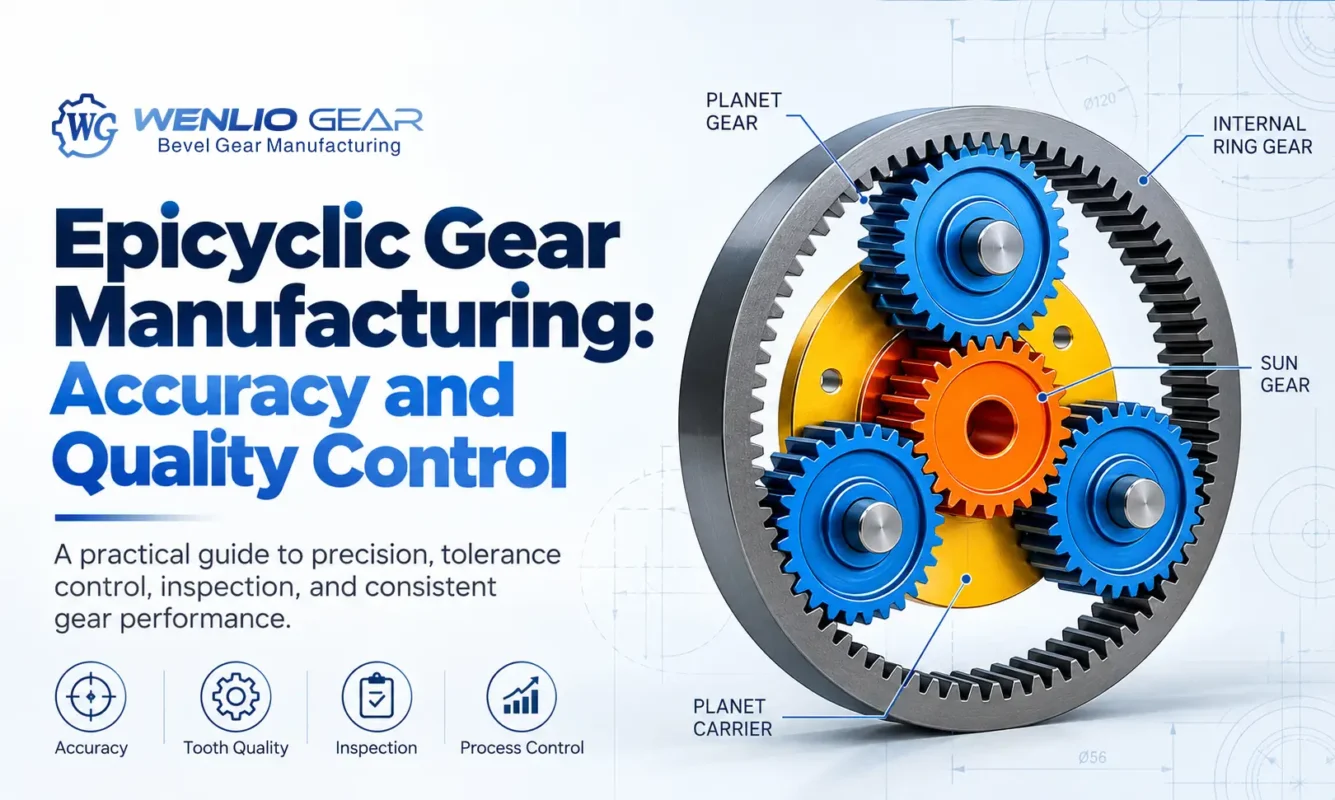
How an Epicyclic Gear System Works
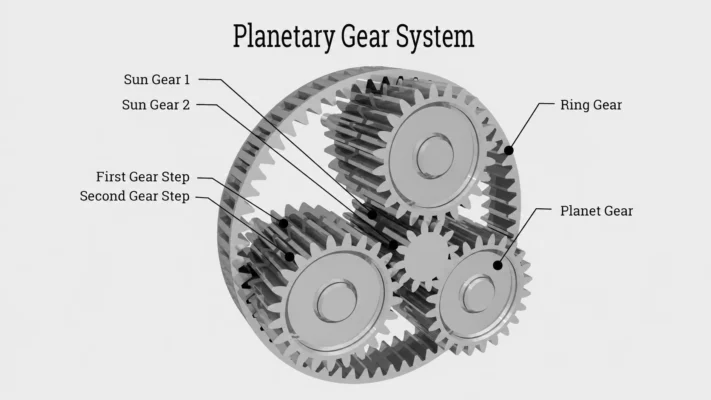
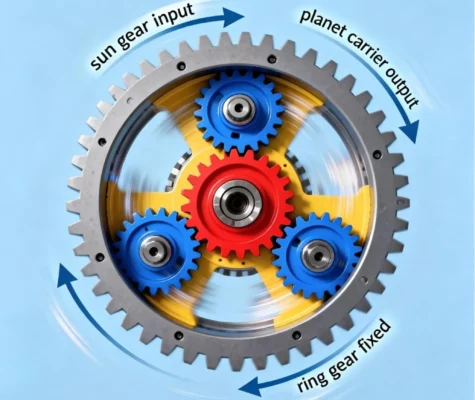
A common planetary stage contains a central sun gear, multiple planet gears, an internally toothed ring gear, and a planet carrier that holds the planet pins. The planet gears spin around their own axes while moving around the sun gear.
Unlike bevel gears, which are generally selected to transfer power between angled shafts, planetary trains are useful when a compact, often coaxial arrangement is needed. That distinction matters when comparing bevel and planetary gear layouts for a new transmission.
Several planets may share the transmitted load, but the share is rarely perfectly equal. Gear errors, carrier movement, and bearing conditions can make one planet work harder than another. Manufacturing must account for the intended assembly.
The Accuracy Problems That Matter Most
Tooth Profile and Helix Deviations
Tooth profile deviation describes a difference between the finished tooth shape and its intended form. Helix deviation describes an error along the face width. Excessive deviations can change the contact between mating teeth, increasing transmission error, vibration, or local tooth stress. In heavy-duty drives, concentrated contact may contribute to pitting and premature wear.
A bore diameter or outside diameter measurement cannot show these problems. Measure tooth profile and helix against agreed tolerances when required.
Radial Runout and Eccentricity
If the gear teeth are not centered on the mounting axis, meshing conditions can vary once per revolution. That variation can introduce vibration and change the loads carried by the planet gears. For example, a sun gear may have acceptable tooth shape but still run unevenly if its teeth are eccentric to the bore used for assembly.
Use the actual mounting surfaces as machining and inspection references.
Planet Pin Position and Load Sharing
Planet pin positions deserve particular attention. In a three-planet arrangement, a small position error in one pin can alter its mesh with the sun and ring gears. The three planets may then carry different loads, leaving one more exposed to fatigue or local wear.
Accuracy alone does not tell the whole story. Carrier stiffness, bearing support, clearances, and a floating or fixed sun-gear arrangement can also influence load sharing. Uneven tooth damage calls for checking both assembly conditions and gear measurements.
Heat Treatment Distortion
Steel gears often need heat treatment to meet strength or wear requirements. Carburizing, induction hardening, nitriding, and quenching and tempering are options for different materials and duties. However, heating and cooling can change tooth geometry, bore dimensions, flatness, or roundness.
Thin-walled ring gears may be especially sensitive. The process plan should allow for distortion and specify any needed finishing after heat treatment.
Choosing the Right Manufacturing Process
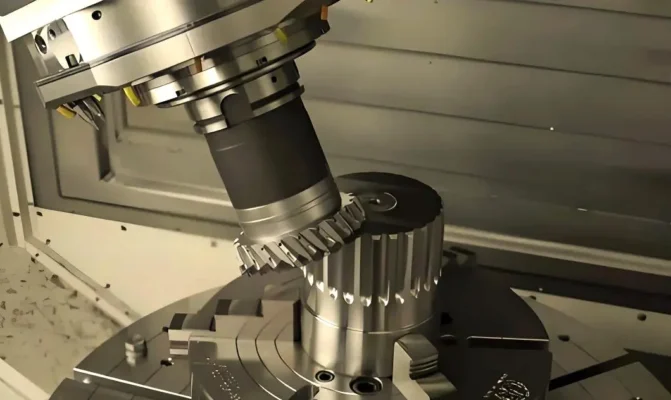
Sun and planet gears normally have external teeth. Gear hobbing is widely used for external spur and helical gears, particularly in repeat production. Gear shaping can be useful where part geometry limits tool access. For more detail on how the cutting method works, Wenlio’s explanation of gear hobbing covers the main process considerations.
An internal ring gear presents a different challenge: the cutter must work inside the component. Shaping is a common solution; power skiving may also be suitable where tooling, machine capability, and geometry allow it. Workholding and distortion become especially important for large or thin rings, making internal gear manufacturing a separate planning task from cutting ordinary external teeth.
A typical route for a heat-treated precision gear is blank machining, datum preparation, tooth cutting, heat treatment, finishing, and inspection. The sequence varies by part. Grinding is not always required; the route should match accuracy, duty, and cost.
Manufacturing Errors and Inspection Priorities
Different errors call for different measurements. The table below connects common production concerns with their possible effects on a planetary stage.
| Manufacturing concern | Possible effect | What to inspect |
| Tooth profile deviation | Transmission error, vibration | Profile geometry |
| Helix deviation | Uneven tooth contact | Helix geometry |
| Pitch deviation | Irregular engagement | Tooth pitch |
| Radial runout | Cyclic mesh variation | Runout to assembly datum |
| Planet pin position | Uneven planet loading | Carrier hole positions |
| Heat treatment distortion | Changed size or geometry | Post-treatment dimensions |
Gearbox noise may involve tooth errors, lubrication, bearing clearance, or assembly alignment. Inspection data should be considered alongside the operating conditions rather than treated as a complete diagnosis by itself.
How Much Gear Accuracy Is Enough?
The highest available accuracy grade is not automatically the best specification. A high-speed, low-noise drive may need close control of tooth profile, helix, and pitch. A slow, heavily loaded system may place equal emphasis on material strength, heat treatment, alignment, and load sharing.
Buyers should identify the features that affect the application and agree on measurable acceptance limits. Tightening every tolerance without a clear reason can add machining cost without addressing the main source of risk. Even highly accurate gears can perform poorly when bearing support or carrier geometry is unsuitable.
Quality Control Before Parts Are Released
A useful inspection plan starts with the drawing, mounting datums, material, and critical operating requirements. Dimensional checks confirm bores, faces, widths, and mounting features. Tooth measurements confirm the specified profile, helix, pitch, and runout characteristics. Material and heat-treatment checks may cover hardness or case depth when required.
For a sun gear, the location of the teeth relative to the mounting bore can matter as much as an individual tooth measurement. For a ring gear, the internal teeth must be evaluated against the relevant installation references. Wenlio’s custom gear quality-control process illustrates how inspection requirements can be agreed before production and checked at the right stages.
Passing component inspection does not prove gearbox performance. Load, temperature, noise, and vibration tests evaluate the assembled system. Buyers and suppliers should agree on which party is responsible for each kind of verification.
What Buyers Should Send for a Custom Gear Quote
A drawing with only the outside diameter and tooth count is usually insufficient. The following information helps identify machining, mating, and inspection requirements early.
| Information | Useful details |
| Drawings or samples | Geometry, dimensions, datums, tolerances |
| Gear tooth data | Module, tooth count, pressure angle, face width, helix if relevant |
| Mating components | Sun/planet/ring relationship and carrier layout |
| Material and treatment | Material grade, hardness, treatment requirements |
| Accuracy requirements | Critical deviations and acceptance method |
| Operating conditions | Torque, speed, duty, lubrication, noise targets |
| Order details | Prototype quantity, production volume, target timing |
For projects still at the drawing-review stage, questions about mating geometry and functional datums can be handled during a custom gear design and manufacturing review. Existing samples and photographs are useful starting points, but a worn part may not preserve its original tooth geometry. Mating details still need confirmation before production.
Working With Wenlio on Custom Gear Components
Wenlio supports custom gear projects that require coordinated tooth cutting, heat-treatment planning, finishing, and inspection. For a sun gear, planet gear, or ring gear, the final manufacturing route depends on the actual drawing, geometry, material, and acceptance requirements. Component-manufacturing capability should not be confused with a claim to supply or validate an entire planetary gearbox.
Before approving production, confirm the machining datums, critical gear deviations, heat-treatment plan, inspection records, and the exact scope of supply. These checks can reduce rework and assembly questions.

Frequently Asked Questions
Is an epicyclic gear the same as a planetary gear?
The terms are often used interchangeably in everyday engineering discussions. More precisely, an epicyclic gear train is a broad category, and a planetary gear train is one common arrangement within it.
Why does load sharing matter in planetary gears?
If the planets do not carry the intended share of torque, some teeth and bearings can experience higher loads. Gear errors, pin positions, carrier stiffness, and assembly conditions can all play a part.
Do all planet gears need grinding?
No. Grinding may be necessary for some hardened, high-accuracy gears, but hobbing, shaping, and other finishing routes can be suitable when they meet the project’s specified requirements.
What causes uneven wear in a planetary gearbox?
Possible causes include unequal planet loading, tooth geometry errors, poor lubrication, misalignment, or operating conditions outside the design assumptions. The damage pattern and operating history are both useful when investigating the cause.
Can custom planetary gears be made from samples?
A sample can support an initial review, especially when a drawing is unavailable. However, worn teeth may hide the original shape. Mating gear data, material, installation dimensions, and acceptance criteria should be confirmed before manufacturing.
conclusion
Reliable epicyclic gear manufacturing is about the relationship between parts, not just the accuracy of an individual gear. Tooth geometry, datums, heat treatment, carrier positions, and inspection planning all affect whether the components will work together as intended.
If you are sourcing custom sun gears, planet gears, internal ring gears, or related transmission components, Contact Wenlio with your drawing, sample details, and operating conditions for a manufacturing review and quotation discussion.
