
Blogs, Bevel Gear
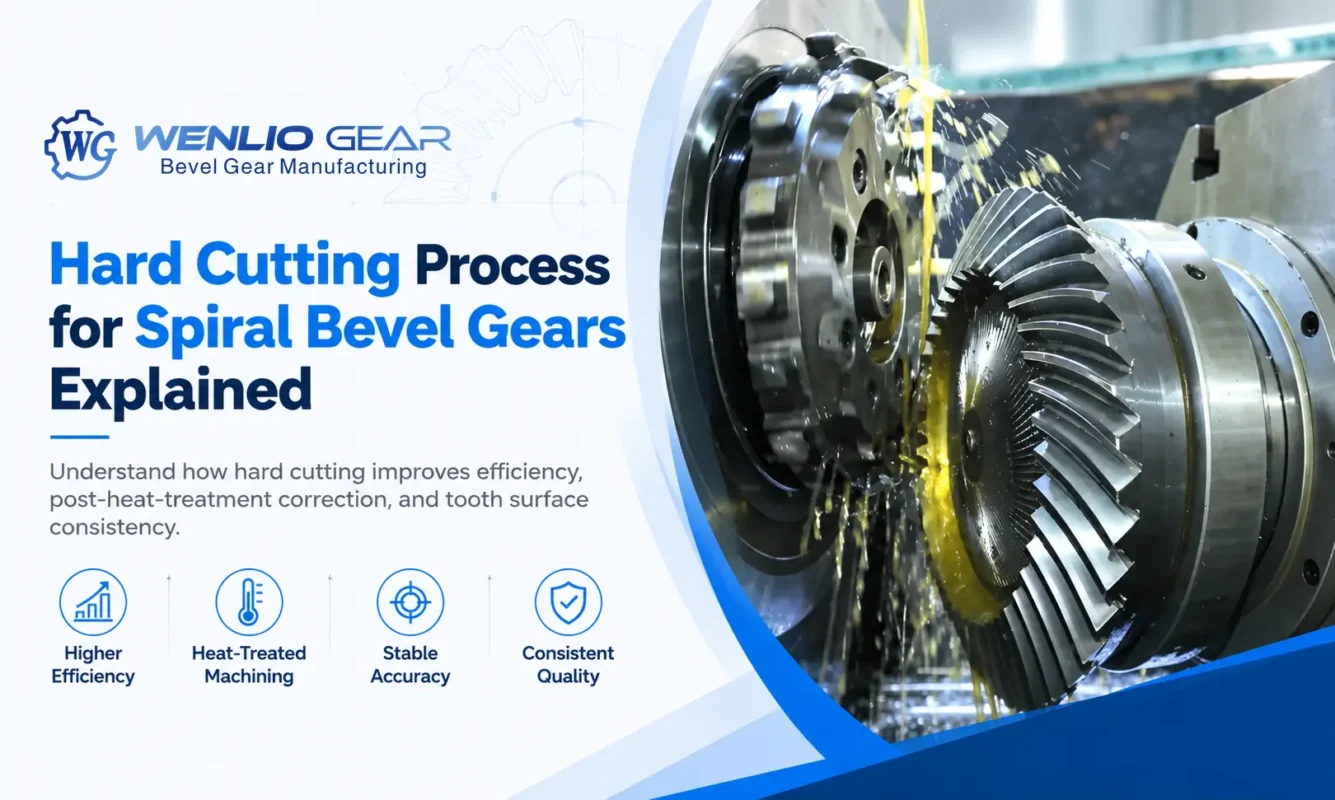
Hard Cutting Process for Spiral Bevel Gears Explained
Sep
Spiral bevel gears are used in car drivetrains, farm machinery, construction equipment, and industrial drives. They run smoother than standard gears, carry more load, and transmit power better. That’s why they’re often chosen for jobs where reliable power transfer matters.
Their curved teeth, though, are tricky to manufacture accurately. After heat treatment, gear makers traditionally grind the teeth to get the required accuracy and surface finish. Newer cutting tools, CNC machines, and machining methods have changed that. Hard cutting is now a practical way to produce spiral bevel gears faster while keeping quality consistent.
As a specialized bevel gear manufacturer, Wenlio provides custom spiral bevel gear solutions based on customer drawings, samples, and application requirements, supporting industries such as agricultural machinery, automotive systems, and industrial equipment.
What Is the Hard Cutting Process for Spiral Bevel Gears?
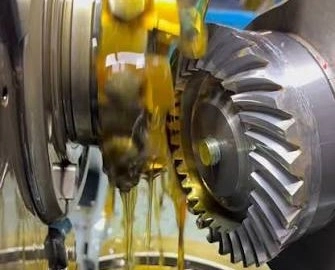
Hard cutting refers to machining the gear tooth surface after heat treatment when the gear has already reached a high hardness level.
A traditional manufacturing process usually includes:
Rough Machining → Heat Treatment → Gear Grinding → Inspection
With hard cutting technology, part of the grinding process can be replaced:
Rough Machining → Heat Treatment → Hard Cutting → Inspection
This approach helps reduce machining steps while maintaining the required tooth accuracy and surface performance.
For spiral bevel gears, because the tooth surfaces are complex three-dimensional curved surfaces, successful hard cutting requires a combination of:
- High-rigidity CNC equipment
- High-performance cutting tools
- Optimized machining parameters
- Stable process control
Only with proper process management can the final gear meet design requirements.
Why Is Hard Cutting Important for Spiral Bevel Gears?
Higher Manufacturing Efficiency
Traditional gear grinding can achieve excellent accuracy, but the process usually requires longer machining time, especially for complex tooth surfaces.
Hard cutting technology improves efficiency by increasing cutting performance and optimizing machining paths. This can shorten production cycles and improve manufacturing capacity.
For gear projects requiring continuous supply, such as:
- Automotive differential gears
- Construction equipment gears
- Agricultural machinery gears
Improved machining efficiency can help shorten delivery time and support stable production.
Better Control After Heat Treatment
Heat treatment processes such as carburizing and quenching improve gear strength but may also cause dimensional changes or tooth deformation.
Traditional methods often rely on grinding to remove these effects by leaving additional machining allowance.
Hard cutting allows manufacturers to directly correct tooth surfaces after heat treatment, helping improve:
- Tooth profile stability
- Dimensional accuracy
- Manufacturing consistency
This is especially valuable for precision spiral bevel gear production.
Improved Tooth Surface Quality
The contact condition between gear teeth directly affects:
- Noise level
- Vibration
- Service life
- Transmission efficiency
By optimizing tool movement and machining parameters, hard cutting can help improve:
- Tooth profile accuracy
- Tooth alignment accuracy
- Surface finish
As a result, gears can achieve more stable meshing performance during operation.
Key Factors Affecting Hard Cutting Quality
Cutting Tool Performance
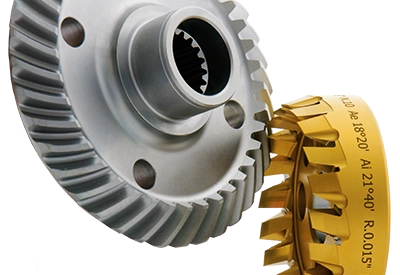
Hard gear cutting places higher demands on cutting tools.
The tools used for this process need to provide:
- High hardness
- Excellent wear resistance
- Stable cutting performance
Tool wear can directly influence:
- Tooth profile accuracy
- Surface quality
- Batch consistency
Therefore, proper tool life management is important for production stability.
Machining Parameter Control
Hard cutting is not simply about increasing cutting speed.
The correct machining parameters need to consider several factors:
| Parameter | Influence |
| Cutting speed | Affects efficiency and tool life |
| Feed rate | Influences tooth surface quality |
| Cutting depth | Affects machining stability |
| Cooling method | Helps control heat generation |
Incorrect parameter settings may result in:
- Tooth surface damage
- Faster tool wear
- Reduced accuracy
Equipment Accuracy
Spiral bevel gears are precision transmission components, so equipment stability plays an important role in manufacturing quality.
Hard cutting equipment requires:
- High structural rigidity
- High-precision spindle systems
- Stable CNC control
- Accurate positioning capability
Any equipment error may directly affect the final gear performance.
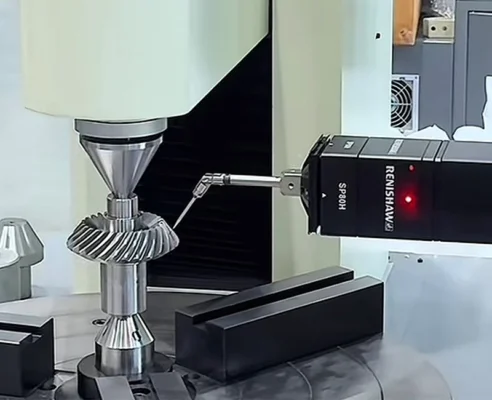
How Are Hard-Cut Spiral Bevel Gears Inspected?
After machining, spiral bevel gears still require strict inspection to verify performance.
Common inspection methods include:
Tooth Profile Inspection
This confirms whether the actual tooth shape matches the designed profile.
Tooth Alignment Inspection
This checks errors along the tooth width direction.
Contact Pattern Analysis
This verifies whether the mating gears achieve the expected contact area and meshing condition.
Dimensional Inspection
Important dimensions include:
- Tooth thickness
- Cone distance
- Mounting dimensions
- Runout tolerance
For high-performance applications, manufacturers may also use gear inspection machines and coordinate measuring machines (CMM) to verify accuracy.
Applications of Hard-Cut Spiral Bevel Gears
Due to their efficiency and precision advantages, hard-cut spiral bevel gears are used in various demanding applications.
Automotive Applications
Typical uses include:
- Differential gears
- Drive system gears
- Electric vehicle transmission components
These applications require:
- Low operating noise
- High reliability
- Long service life
Construction Equipment
Examples include:
- Excavators
- Cranes
- Mining equipment
These machines require gears that can withstand:
- High loads
- Long operating hours
- Impact forces
Agricultural Machinery
Agricultural equipment often operates in challenging environments with:
- Dust exposure
- Continuous operation
- High torque requirements
Stable tooth quality helps improve equipment reliability and operating performance.
Hard Cutting vs Gear Grinding: How to Choose?
Both hard cutting and grinding have their own advantages.
| Item | Hard Cutting | Gear Grinding |
| Machining efficiency | Higher | Relatively lower |
| Production cost | Lower | Higher |
| Hard gear machining | Applicable | Common method |
| Surface quality | Depends on process control | Highly stable |
| Suitable applications | High-efficiency production | Extremely high accuracy requirements |
The appropriate process depends on:
- Required gear accuracy
- Application conditions
- Production volume
- Cost objectives
A professional manufacturer will select the right process based on the complete project requirements.
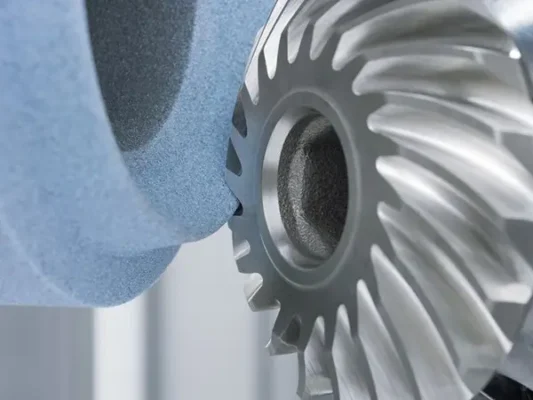
How Wenlio Supports Precision Spiral Bevel Gear Manufacturing
For custom spiral bevel gear projects, manufacturing quality depends on the complete process chain, not a single machining step.
Wenlio provides customized bevel gear solutions based on customer drawings, samples, and application requirements for industries including agricultural machinery, automotive systems, and industrial equipment.
During production, key factors include:
- Gear design review
- Material selection
- Heat treatment control
- Tooth surface machining
- Final inspection
Through a complete manufacturing and quality control process, Wenlio helps customers achieve reliable and consistent transmission components.
FAQ
What Is Hard Cutting For Spiral Bevel Gears?
Hard cutting is a machining process that finishes the gear teeth after heat treatment. It helps improve production efficiency while maintaining stable gear accuracy.
Is Hard Cutting Better Than Gear Grinding?
It depends on the application. Hard cutting offers higher efficiency, while grinding is often chosen for applications requiring extremely high surface quality and accuracy.
Can You Make Spiral Bevel Gears With Hard Cutting?
Yes. Hard cutting can be used for custom spiral bevel gears when the right equipment, tools, and machining parameters are applied.
What Affects The Quality Of Spiral Bevel Gears?
Gear quality depends on many factors, including material, heat treatment, machining accuracy, and final inspection.
What Do I Need To Provide For A Custom Spiral Bevel Gear Quote?
You can provide drawings, samples, OEM numbers, or application details. These details help the supplier evaluate the right manufacturing process and solution.
Conclusion
Hard cutting has become a practical way to finish spiral bevel gears in precision manufacturing. When it’s set up properly, it can raise efficiency, cut down on processing steps, and keep gear quality consistent. But it isn’t a one-size-fits-all replacement for other finishing methods. The right choice still comes down to gear design, accuracy requirements, operating conditions, and production targets.
When you’re sourcing high-performance spiral bevel gears, the supplier makes a big difference. Solid design capability, practical machining experience, and dependable inspection are what determine whether the gears deliver reliable transmission performance.If you need custom spiral bevel gear solutions, Contact Wenlio to discuss your drawings, samples, or application requirements. You’ll receive a technical review for your project.
