
Blogs
When Should You Use a Sprocket Instead of a Gear?
Sep
At first glance, sprockets and gears can look like parts that do the same job. Both pass rotary motion and torque from one shaft to another. The difference is in how they do it: gears work through direct tooth-to-tooth contact, while a sprocket normally drives a roller chain, and the chain carries motion to another sprocket.
That small difference changes the whole layout. Shaft spacing, ratio, speed, load, available space, motion accuracy, backlash and maintenance access all matter. So the real question is not “which one is better?” It is “which drive fits the machine and the way it will be serviced?”.Wenlio can help review the gear type, drawing details, application conditions and inspection requirements before quotation.
Which One Fits Your Application Better?
In many sourcing conversations, this is the easiest place to start. If the shafts sit far apart, or if one chain has to reach several positions, a sprocket drive may be the more practical answer. If the drive has to stay compact, hold a stable angular relationship, or control backlash more closely, a gear drive is normally the better direction to review first.
A quick way to think about it:
- Longer shaft distance -> sprocket
- Multiple driven positions -> sprocket
- Compact transmission layout -> gear
- Higher positioning accuracy -> gear
Speed, torque, installation space and maintenance conditions still need to be checked before the final choice is made.
How Do Sprockets and Gears Transfer Power?
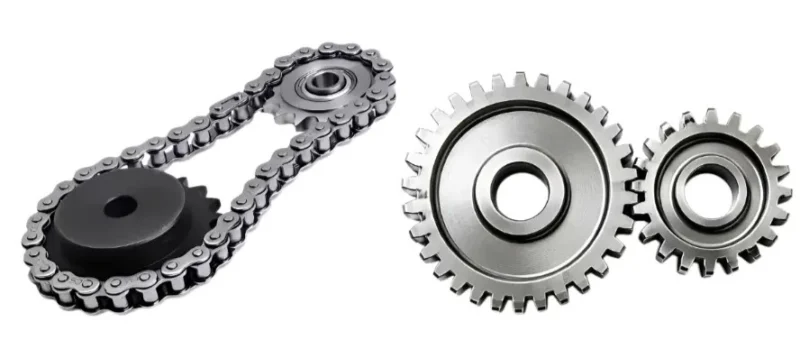
Power transfer is the key difference. A gear pair transfers motion through direct tooth-to-tooth contact, while a sprocket engages a chain to drive another sprocket.
This changes the design requirements. Chain drives offer more flexibility in shaft spacing but require attention to chain tension, elongation and lubrication. Gear pairs provide more direct motion transfer but usually need closer shaft spacing and tighter control of meshing conditions.
| Comparison | Sprocket Drive | Gear Drive |
| Power transmission | Through a chain | Direct tooth contact |
| Shaft distance | Easier to use over longer centers | Usually needs closer shaft positions |
| Layout flexibility | Good when the route must reach several points | More fixed once shaft positions are set |
| Transmission accuracy | Can change as the chain wears or stretches | More stable when properly made and installed |
| Positioning capability | Suitable for general motion | Better for controlled motion and low backlash |
| Maintenance focus | Chain tension, lubrication and wear | Tooth contact, lubrication and alignment |
| Typical applications | Conveyors, agricultural machinery and industrial drives | Gearboxes, reducers and precision drives |
They overlap in broad power transmission work, but one should not be treated as a simple replacement for the other.
When Does a Sprocket Make More Sense?
When the Shafts Are Far Apart
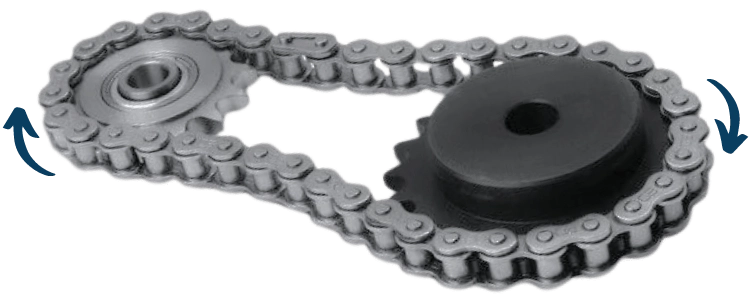
A long center distance is one of the clearest reasons to consider a sprocket. If two shafts are too far apart for direct gear meshing, a chain can bridge the distance without building a train of extra idler gears. That is why sprockets appear so often in conveyors, agricultural machinery, packaging lines and material handling equipment.
When One Drive Needs to Connect Multiple Shafts
Some layouts need one motor or driving shaft to move several positions. With a chain path, more than one sprocket can be included in the same drive. This can keep the layout simpler than using several gear stages.
The trade-off is maintenance. As the chain route gets longer, tension, shaft alignment, lubrication and wear checks become more important.
When Easy Access and Maintenance Matter
Open machines often use chain drives because the wear points are easy to see. Operators can check tension, look for elongation, and replace the chain or sprockets without opening a sealed reducer.
This advantage only works if maintenance is actually done. Poor lubrication or misalignment can quickly show up as noise, vibration and uneven tooth wear.
When Is a Gear Drive More Suitable?
When the System Needs a Compact Layout
Gear drives make more sense when the machine has limited room. Inside gearboxes, reducers and transmissions, gears can reduce speed, transmit torque or turn the direction of motion in a small space.
Spur gears are often used between parallel shafts. Bevel gears are used when motion has to be transferred between intersecting shafts. In this type of layout, adding a chain would often take more space, not less.
When Transmission Accuracy Is Important
Where the speed relationship needs to stay consistent, a gear drive is often easier to control. The ratio is set by the tooth counts and the meshing geometry.
A sprocket ratio also depends on tooth count, but the actual running behavior can shift with chain elongation, tension, wear and installation quality. For machines that need steady motion over time, those details cannot be ignored.
When Positioning and Backlash Matter
In automation, servo drives, robotics and precision reducers, torque is only part of the job. The motion also has to arrive at the right angle and repeat it.
Gear accuracy, tooth profile, backlash and contact pattern all affect that result. A chain drive has clearance between links, and that clearance can grow with use. For tighter positioning or controlled backlash, gears are normally the better starting point.
What Should You Check Before Choosing?
Before choosing the part name, check the working conditions. This avoids a common mistake: selecting the drive type first and forcing the machine layout to fit it.
Shaft Center Distance
Start with the distance between the driving and driven shafts. A longer distance often points toward a chain and sprocket arrangement. A short distance may make direct gear engagement simpler.
Also check whether the center distance is fixed or adjustable. Chain systems often need space for tensioning.
Speed and Torque
Input speed and torque should be reviewed together. At higher chain speed, noise, vibration, dynamic load and lubrication demand become more noticeable.
For heavier loads, the design is not just “sprocket or gear.” It also involves chain size, sprocket diameter, gear module, material, heat treatment and tooth strength.
Required Transmission Ratio
Both drive types can change speed and torque through tooth-count ratios. In a chain drive, the driving and driven sprocket tooth counts set the nominal ratio. Gear pairs work under the same basic idea.
The ratio still needs to fit the whole envelope: outside diameter, center distance, input and output speed, torque and available installation space. A ratio that looks good on paper may be awkward if the part becomes too large or the shafts cannot be moved.
Accuracy Requirements
Accuracy is often the deciding point. For conveying or general power transfer, a sprocket drive may do the job well.
For precise positioning, stable angular timing, low backlash or controlled motion, a gear drive should be reviewed more carefully. This is especially true when the drive is connected to a servo system or precision reducer.
Maintenance Conditions
Think about where the drive will live. Chain drives need periodic tension, lubrication and wear checks. If the area is open and easy to reach, that may be acceptable.
If the unit is difficult to access or frequent adjustment is not realistic, the maintenance burden should be considered early. A closed gear drive may reduce routine adjustment, although lubrication and correct installation still matter.
What Matters If You Choose a Sprocket?
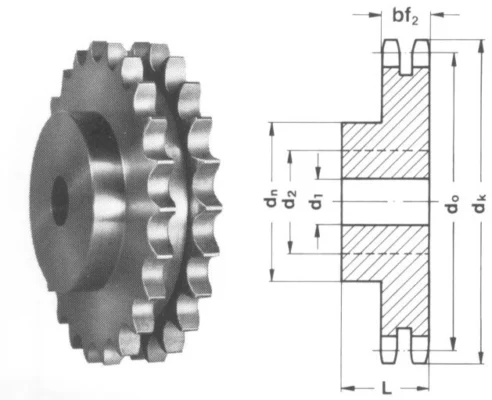
If a sprocket is selected, the outside diameter alone is not enough for manufacturing. Several basic details need to be confirmed before the part can be checked properly.
Chain Pitch
The sprocket must match the roller chain pitch. Two sprockets can look similar from a distance, but if the pitch is wrong, the chain will not seat correctly.
Tooth Count
Tooth count affects the ratio, outside size, chain engagement and running smoothness. Reducing the tooth count just to save space can create rougher running or higher wear, so it should be checked as part of the whole drive design.
Bore and Keyway
The sprocket also has to fit the shaft. Bore diameter, keyway size, hub shape, shaft tolerance and mounting method should be reviewed together.
These details may look secondary, but they often decide whether the part can be assembled without rework.
Material and Heat Treatment
The right material and hardness depend on load, speed, environment and expected service life. Higher hardness is not automatically better if toughness, machining, cost or mating parts have not been considered.
Why Choose Wenlio for Your Gear Project?
If the review points toward a gear drive, the next step is to confirm the gear type, material, heat treatment, accuracy grade and inspection requirements.
Wenlio supports custom gear projects from drawings, 3D models and application details. Our review focuses on geometry, tooth contact, matching conditions and inspection requirements, so the project is clearer before manufacturing begins.
For bevel gears, spiral bevel gears, hypoid gears and other custom gear projects, send your drawing or project information to Wenlio for review.
FAQ About Sprockets and Gears
Is a sprocket the same as a gear?
No. A gear meshes directly with another gear. A sprocket transfers motion through a chain, so chain pitch, chain condition and tension become part of the design.
When should I use a sprocket instead of a gear?
Consider a sprocket when the shafts are far apart, one chain must drive several positions, or the machine layout needs more routing flexibility.
Which is better for precise positioning?
Gear drives are normally the stronger choice for precise positioning, stable angular motion and lower backlash. The final decision still depends on the full drive design.
Can sprockets handle high torque?
Yes, but the chain size, sprocket size, speed, load, lubrication and operating environment need to be reviewed together.
What information is needed for a custom gear project?
Useful information includes drawings or 3D models, gear specifications, material, heat treatment, accuracy requirements, quantity and operating conditions.
Conclusion
Sprockets and gears both transmit mechanical power, but they solve different layout problems. Sprockets are practical for longer shaft distances, conveyors and machines that need flexible chain routing. Gear drives are a better fit for compact systems, stable ratios and motion that needs closer accuracy control.
The better question is not whether a sprocket or a gear is universally better. It is which drive matches the required speed, torque, center distance, accuracy and maintenance conditions. If your application needs a precision gear solution, Contact Wenlio with your drawing, 3D model or project requirements for review.
