
Blogs, Bevel Gear
Ground Spiral Bevel Gears: When Is Grinding Worth It?
Sep
Introduction
Ground spiral bevel gears are not necessary for every application. In many industrial drives, a properly cut, heat-treated, and lapped gear set can already meet the required accuracy, contact, and running performance. At Wenlio, the finishing route is selected according to the actual gear and application requirements.
Grinding becomes more valuable when tighter post-heat-treatment accuracy, lower noise, higher-speed operation, or better batch consistency is required. The key question is not whether grinding is “better,” but whether the project really needs the extra control it provides.
What Are Ground Spiral Bevel Gears?
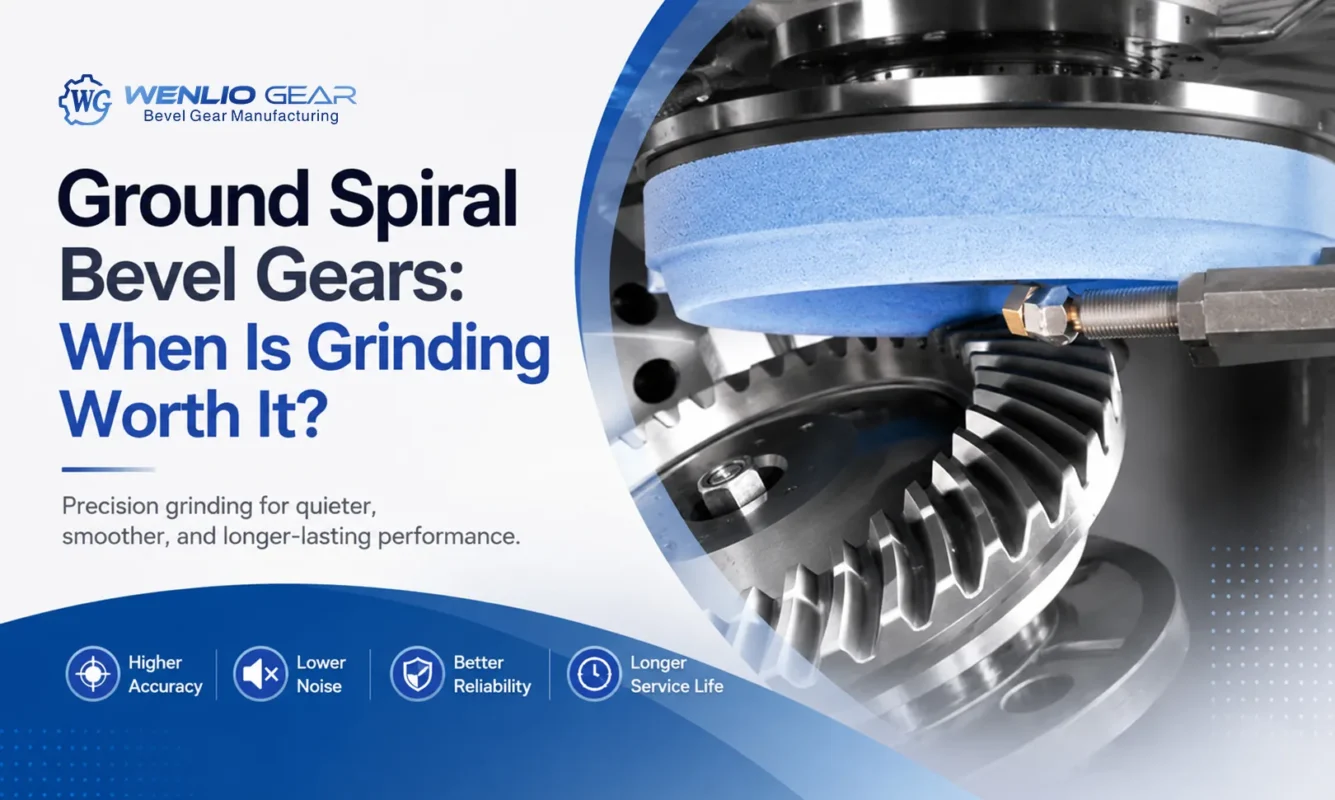
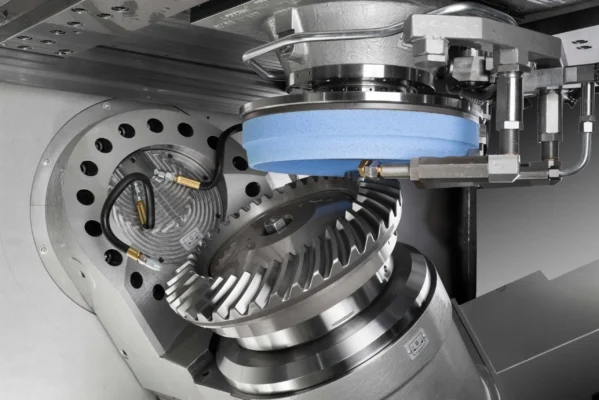
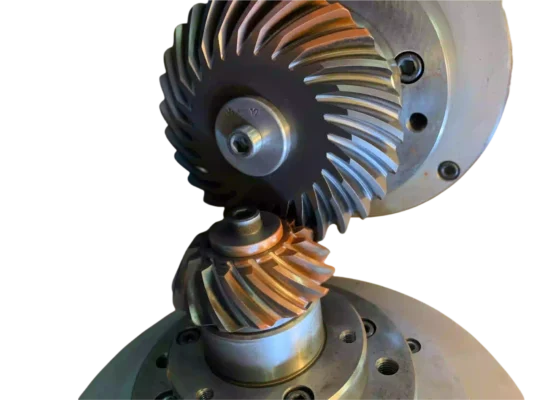
Ground spiral bevel gears are spiral bevel gears whose tooth flanks are precision-ground, normally after heat treatment.
A typical route is:
Blank machining → Gear cutting → Heat treatment → Gear grinding → Inspection
Grinding is a hard-finishing process. It removes a controlled amount of material from the hardened tooth surface to bring the final flank geometry and surface condition closer to the specified target.
The route has to be considered early. Face-milled spiral bevel gears are commonly suitable for grinding after heat treatment, while face-hobbed designs may use lapping or another finishing route compatible with the original tooth generation method.
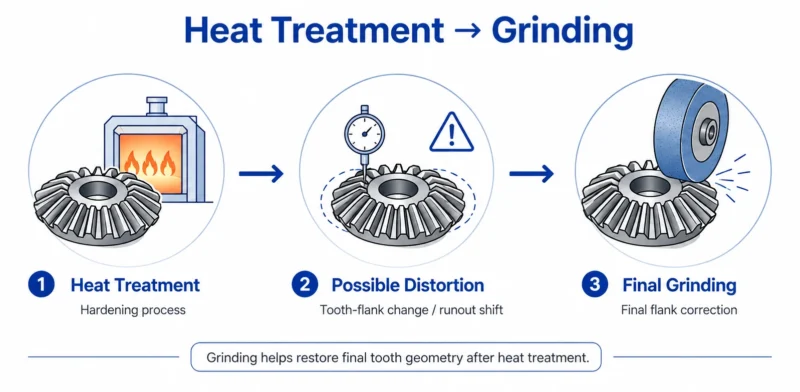
Heat treatment is one reason this planning matters. Carburizing and quenching can change tooth-flank geometry and runout. Where tighter control is required, gear grinding after heat treatment allows the hardened tooth surface to be finished again before final inspection.
Why Grind Spiral Bevel Gears After Heat Treatment?
The main reason is to control what remains after hardening.
Heat treatment can introduce tooth-flank distortion, runout changes, pitch-related deviation, or local variation. The amount depends on the material, part geometry, heating and cooling conditions, and the gear condition before heat treatment.
If sufficient grinding stock has been left, final grinding can correct part of these changes and bring the tooth flanks closer to the required geometry.
There are limits. Excessive distortion or an unsuitable grinding allowance cannot always be corrected in the final operation. Grinding works best when it is planned as part of the full manufacturing route, not used as a last-minute fix.
When Are Ground Spiral Bevel Gears Worth the Cost?
A drawing marked “high precision” is not enough by itself to justify grinding. The finished performance and inspection requirements should drive the choice.
When Post-Heat-Treatment Accuracy Is Hard to Hold
Some gears are acceptable before heat treatment but no longer stay within the required tolerance after hardening.
In that situation, grinding adds a controlled finishing stage after heat treatment. The required gear accuracy grade should be defined before the process route is selected.
Two gears of similar size may need different finishing methods because their speed, load, mounting condition, and inspection criteria are different.
When the Gear Runs at Higher Speed
At higher speed, small geometry or mounting errors can become more noticeable through vibration and noise.
Grinding can improve control of the finished tooth flank, but it cannot compensate for poor installation. Mounting distance, backlash, shaft alignment, and bearing support still need to be correct.
A well-ground gear set installed in the wrong position can still perform badly.
When Noise Is a Design Concern
Grinding may help when flank accuracy contributes to noise, but it should not be treated as a guaranteed noise cure.
The bevel gear contact pattern, backlash, mounting position, bearings, lubrication, and operating load all affect how a spiral bevel gear set runs. A quiet gear set is usually the result of the complete design and assembly condition, not one finishing process.
When Batch Consistency Matters
Prototype approval is only part of a recurring production project. Later batches still need to remain within the same limits.
Grinding can be useful when tooth geometry and inspection results need tighter batch-to-batch control. But consistency still depends on the full route:
Cutting → Heat treatment → Grinding → Inspection
Stable results come from controlling each stage.
Ground vs Lapped Spiral Bevel Gears
Grinding and lapping solve different manufacturing problems. It is more useful to compare their functions than to describe one as “better.”
| Factor | Ground Spiral Bevel Gears | Lapped Spiral Bevel Gears |
| Main purpose | Hard finishing and flank control | Improve mating contact |
| Typical stage | After heat treatment | Usually after heat treatment |
| Material removal | Direct grinding of hardened flanks | Light removal while gear and pinion run together |
| Pair dependence | Geometry can be controlled to defined targets | Members are commonly kept as a matched pair |
| Surface condition | Produced by grinding | Refined through mating action |
| Cost | Usually higher | Often lower |
| Typical use | Tighter accuracy or repeatability needs | Many paired industrial bevel gear applications |
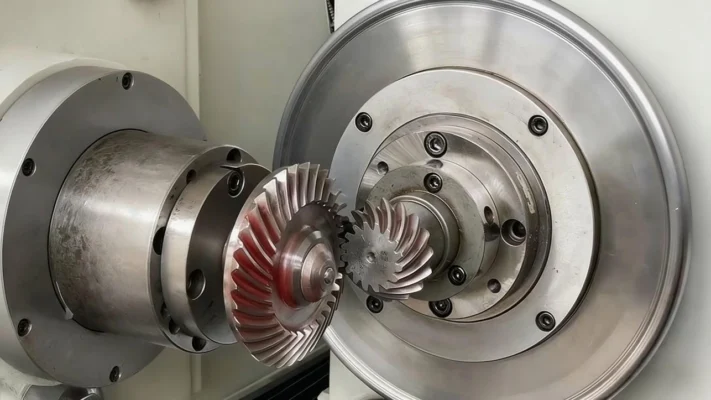
With grinding, the hardened tooth surface is directly machined. With lapping, the gear and pinion run together under controlled conditions so a small amount of material is removed from the mating surfaces.
Because lapped members are finished together, pair identification is important. For a matched bevel gear set, the gear and pinion should remain traceable as a pair when required by the manufacturing plan.
Does Every Spiral Bevel Gear Need Grinding?
No.
If a proven cut, heat-treated, and lapped gear set already meets the required accuracy, backlash, contact pattern, load, noise, and service-life targets, grinding may add cost and lead time without a meaningful advantage.
This is why “ground” should not be used as a shortcut for “better.” The useful question is whether the project needs tighter control of the hardened tooth flanks than the existing process can reliably provide.
When May Lapping Be Enough?
Lapping may be the right choice when the established process already delivers the required performance, particularly when the gear and pinion are controlled as a matched pair and the target contact pattern has been validated.
In these projects, pair control, backlash, contact pattern, mounting condition, and identification may matter more than changing the finishing route.
Adding another process step is useful only when it solves a real technical or production problem.
What Should Buyers Specify in an RFQ?
“Ground spiral bevel gear required” is not enough information for a reliable quotation. The RFQ should define the finished requirements that drive the process.
| RFQ Item | What to Provide |
| Drawing / pair data | Drawing revision and mating pinion information |
| Material | Material grade |
| Heat treatment | Process, hardness, case depth if required |
| Accuracy | Standard and grade |
| Tooth surface | Roughness requirement, if specified |
| Pair requirements | Backlash and contact pattern |
| Quantity | Prototype and production volume |
| Application | Speed, torque, duty cycle, noise requirement |
The distinction is important: grinding is a process requirement; accuracy, contact behavior, noise, and service life are performance requirements.
For custom gear projects, the drawing, material, heat treatment, accuracy, operating conditions, mating data, and inspection scope should be reviewed together before the finishing route is confirmed.
Should Ground Spiral Bevel Gears Still Be Checked as a Pair?
Sometimes, yes.
Individual inspection confirms whether each gear meets its specified geometric requirements. Pair-level inspection checks how the gear and pinion work together.
This may still be important where the project includes a defined contact pattern, controlled mounting distance, noise-sensitive operation, higher load, bidirectional running, or gear-and-pinion supply as one set.
Depending on the application, final checks may include backlash, contact pattern, or mounting relationship in addition to individual tooth measurements.
How Should Buyers Decide?
Start with the operating requirement, not the process name.
If a proven cutting, heat-treatment, and lapping route already meets the drawing, contact, load, noise, and production requirements, grinding may not be necessary.
If the project needs tighter post-heat-treatment flank control, more repeatable inspection results, or more demanding running behavior, grinding deserves stronger consideration.
The key is to decide before production how the final gear pair will be judged. Once accuracy, contact, operating conditions, and inspection scope are clear, the process choice becomes much easier to justify.
FAQ
What are ground spiral bevel gears?
They are spiral bevel gears whose hardened tooth flanks are precision-ground to achieve the required final geometry and surface condition.
Are ground spiral bevel gears more accurate than lapped gears?
Grinding usually gives more direct control of the finished tooth-flank geometry. Whether that extra control is necessary depends on the application and inspection requirements.
Can grinding reduce spiral bevel gear noise?
It can help when tooth-flank accuracy contributes to the noise. Backlash, contact pattern, mounting, bearings, lubrication, and load also matter.
Do spiral bevel gears have to be ground after heat treatment?
No. Many spiral bevel gear sets use lapping or other finishing routes. The correct route depends on tooth generation, accuracy targets, and operating requirements.
Are ground spiral bevel gears more expensive?
Usually. Grinding adds setup, machining, process control, and inspection. The added cost is worthwhile only when those steps provide control the project actually needs.
Conclusion
Ground spiral bevel gears are worth considering when tighter control of the hardened tooth flanks is important to final accuracy, repeatability, or running performance. They are not a universal upgrade.
The most practical approach is to define the finished requirements first and choose the manufacturing route around them.
Send your drawing, mating gear data, heat-treatment requirements, quantity, and application information through Contact us for a technical review.
