
Blogs, Bevel Gear, Pinion Gear
Rack and Pinion vs Bevel Gear: Which Fits Your Application
Oct
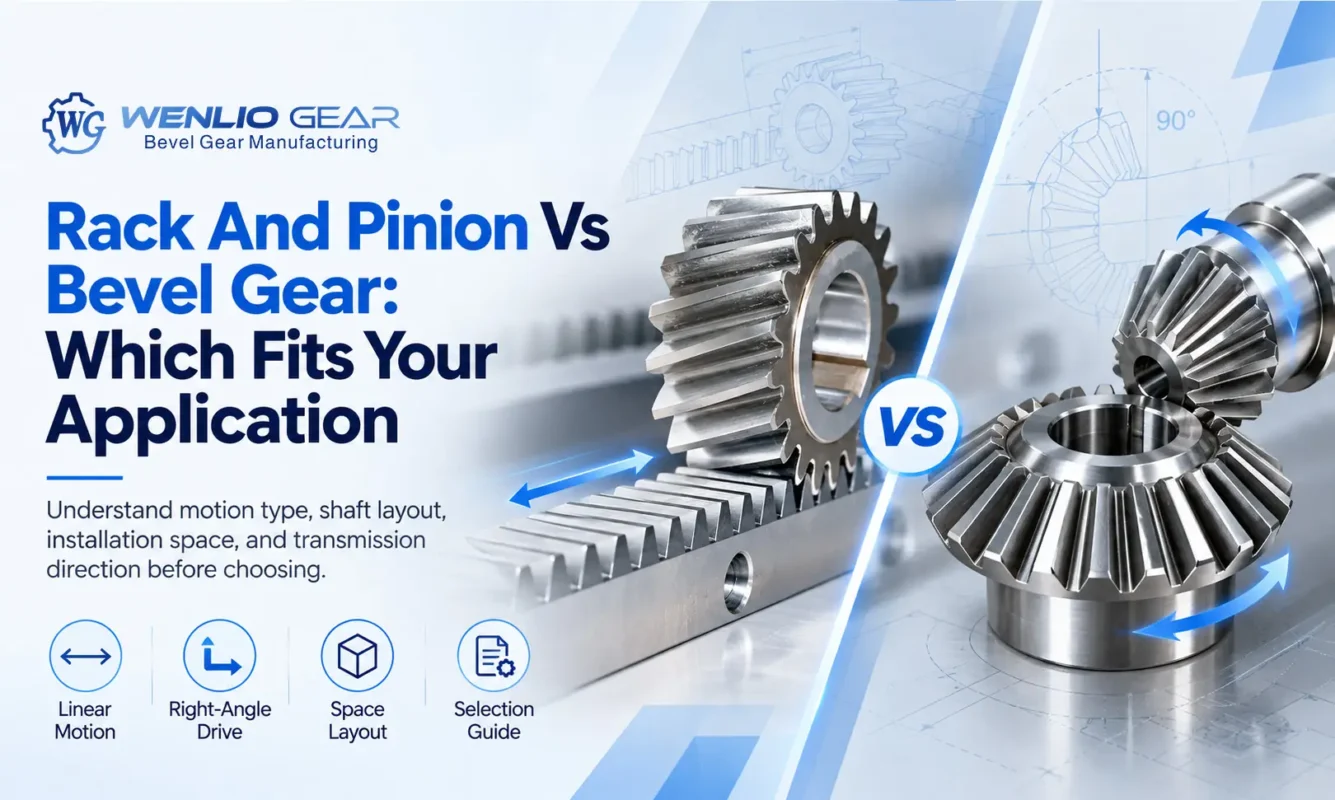
Choosing between rack and pinion and bevel gear isn’t about picking a “better” product. It’s about matching the gear to the motion the machine needs. Both are gear-based transmission solutions, but they solve different problems, and treating them as interchangeable usually ends in rework.
Machines that need to turn rotation into straight-line travel tend to reach for a rack and pinion setup. Machines that need to pass rotary power between two intersecting shafts tend to land on a bevel gear pair. Engineers, OEM buyers, and equipment designers get the best results when they sort out motion direction and shaft layout before they start comparing cost, material, or accuracy.
Wenlio focused on bevel gears and precision transmission, suggests starting with the working conditions themselves — shaft angle, gear ratio, load, speed, installation space, and inspection requirements. From there it’s much easier to see whether a straight bevel gear, spiral bevel gear, miter gear, or another bevel configuration is the right call.
Rack and Pinion or Bevel Gear?
A rack and pinion system is the go-to when rotary motion has to become linear travel. You’ll meet it in linear positioning stages, steering mechanisms, automation equipment, and long-stroke motion structures.
A bevel gear earns its spot when rotary power must travel between shafts that intersect — especially when the power has to change direction somewhere along the way. Gearboxes, differentials, agricultural machinery, construction equipment, and industrial transmission systems are full of them.
In one line: rack and pinion bridges rotation and linear motion; bevel gears carry rotary power around corners.
What Is the Main Difference Between Rack and Pinion and Bevel Gear?
The difference sits in the output motion.
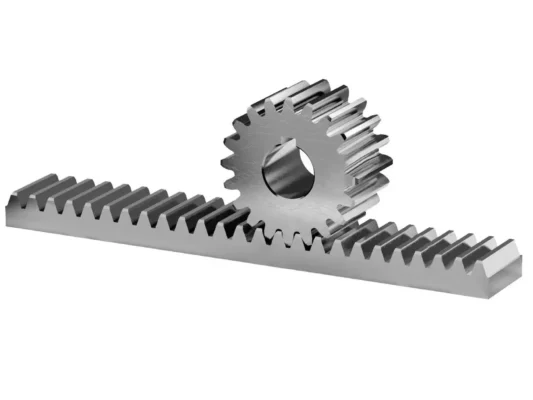
A rack and pinion set pairs a round pinion with a straight rack. Turn the pinion and the rack slides along a straight line — rotation becomes linear movement, and run in reverse, linear movement becomes rotation. The whole system exists for straight-line travel.
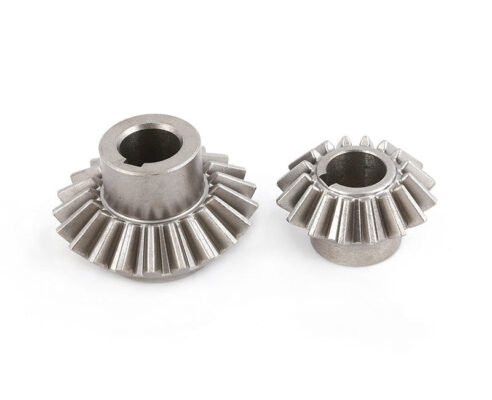
A bevel gear set is a matched pair whose shafts intersect. The two gears hand rotary power from one shaft to the other, redirecting the transmission rather than creating linear movement.
Table 1. Rack and Pinion vs Bevel Gear at a Glance
| Comparison Item | Rack and Pinion | Bevel Gear |
| Main motion type | Rotary ↔ linear | Rotary ↔ rotary |
| Core function | Linear movement, positioning, pushing or pulling | Changing the direction of rotary power |
| Typical structure | Pinion + straight rack | A pair of bevel gears |
| Shaft relationship | Rack moves along a straight line | Two shafts intersect |
| Common applications | Steering systems, automation, machine tool feed systems | Gearboxes, differentials, angle drives |
| Key selection factors | Travel length, backlash, positioning accuracy, rack length | Shaft angle, gear ratio, mounting distance, contact pattern |
These two systems aim at different goals, so they rarely substitute for each other in practice.
How Does Motion Direction Affect Gear Selection?
Ask one question first: what motion should come out of the machine?
The motor spins, but the driven part has to move in a straight line — that’s a rotary-to-linear conversion problem, and rack and pinion handles it directly.
Input and output both stay rotary, but the output shaft needs a new direction — that’s a power-redirecting problem, and a bevel gear set matches the transmission logic better.
Motion direction basically decides the first step of selection. Once it’s clear, the rest — material, heat treatment, accuracy grade, tooth geometry, inspection needs — falls into place much more easily.
When Should You Choose a Rack and Pinion System?
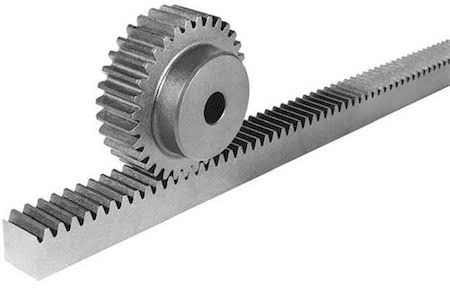
Reach for rack and pinion when the machine needs a long linear stroke, or when rotary input has to be converted into straight-line movement.
Where does it show up? Typical jobs include:
- Linear positioning mechanisms
- Automated moving platforms
- Vehicle steering systems
- Door or lifting mechanisms
- Machine tool feed systems
- Long-travel pushing or pulling structures
Design-wise, the points that matter are rack length, travel distance, backlash control, rack support, lubrication, and positioning accuracy.
But if linear movement isn’t the core requirement at all — if the real need is changing the direction of rotary power — rack and pinion is the wrong place to start.
When Should You Choose a Bevel Gear?
Bevel gears come into their own when rotary power has to be transmitted between two intersecting shafts. Ninety degrees is the classic setup, though other shaft angles can be designed to fit.
They’re everywhere in:
- Gearboxes
- Differential systems
- Agricultural machinery
- Construction equipment
- Heavy-duty transmission systems
- Industrial angle drives
- Power transmission units
Unlike a rack and pinion, a bevel gear isn’t built to generate linear travel. Its strength is changing the direction of rotary power inside a compact package.
And don’t size a bevel gear on tooth count and module alone. Shaft angle, mounting distance, contact pattern, gear accuracy, material, heat treatment, and inspection requirements all have a say in the final choice.
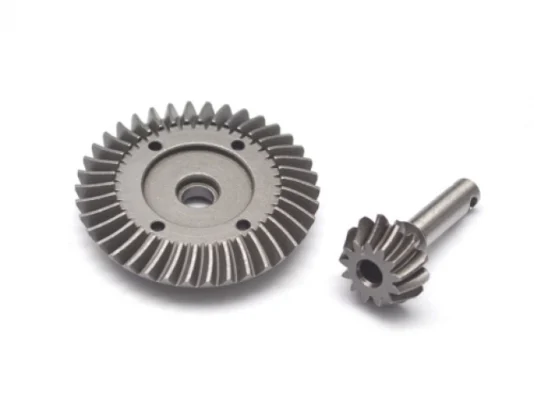
Rack and Pinion vs Bevel Gear: Key Comparison Table
Table 2. Key Comparison: Rack and Pinion vs Bevel Gear
| Selection Factor | Rack and Pinion | Bevel Gear |
| Best for | Converting rotary motion into linear motion | Transmitting rotary power between intersecting shafts |
| Output motion | Linear motion | Rotary motion |
| Typical layout | A pinion drives a straight rack | Two bevel gears mesh at an angle |
| Space requirement | Needs linear installation space | Better for compact angled layouts |
| Accuracy concern | Linear positioning accuracy and backlash | Contact pattern, mounting distance, tooth surface error |
| Load concern | Rack support, tooth strength, lubrication | Tooth contact, torque, bearing support |
| Common issue | Long-travel installation error and backlash | Poor contact pattern, noise, assembly deviation |
| Better choice when | The system needs linear movement | The system needs to change rotary power direction |
The table works as a quick screen, not a full engineering review. On bevel gear projects, mating gear data and assembly conditions often decide how the set performs once it’s installed.
What Should Engineers Check Before Choosing a Gear Type?
Run through this checklist before committing to either option.
Table 3. Selection Checklist
| Check Item | What to Confirm |
| Motion type | Does the system need linear motion or rotary motion? |
| Shaft layout | Do the input and output shafts intersect? What is the shaft angle? |
| Load condition | Is there impact load? What is the required torque or force? |
| Speed | What are the input speed and output speed? |
| Accuracy | Is there any requirement for positioning accuracy, low noise, or low backlash? |
| Installation space | Is there enough space for a long rack or an angled gear set? |
| Working environment | Is there dust, moisture, high temperature, low temperature, or corrosion? |
| Inspection requirement | Are gear profile, lead, hardness, or contact pattern inspection needed? |
Leave any of these gaps open, and suppliers will fill them with their own assumptions during quoting or design review — which is how you get a misleading comparison, a wrong selection, or assembly trouble down the road.
Why Bevel Gear Selection Requires More Than Tooth Count
Tooth count, module, and material only take you so far with bevel gears.
Bevel gears work as matched pairs. A single gear can pass every dimensional check and still fail to deliver the right contact pattern once it’s mounted against its mate. Mounting distance, shaft angle, mating gear data, and bearing support all influence how the pair actually meshes.
That’s especially true for spiral bevel gears, hypoid gears, and miter gears. For a proper evaluation, engineers typically need:
- Gear ratio
- Shaft angle
- Mounting distance
- Face width
- Material and heat treatment
- Accuracy requirement
- Mating gear information
- Contact pattern requirement
- Inspection report requirement
For this reason, Wenlio asks bevel gear clients to send drawings, assembly layouts, sample photos, or an existing transmission structure — not just a bare list of gear parameters.
How to Decide Which One Fits Your Application?
Trace the motion chain from end to end — that’s the fastest way to decide.
If the motor rotates and the driven component has to move in a straight line, rack and pinion is the natural starting point.
If both ends stay rotary but the power direction has to change, start with a bevel gear.
Sometimes the machine needs both, and there’s no rule saying you can’t combine the two: a bevel gear set redirects the rotary power first, then a rack and pinion converts it into linear travel.
So the real question isn’t “which gear is better.” It’s “what does the complete motion chain need to do?”
FAQ
Is rack and pinion the same as bevel gear?
No. Rack and pinion turns rotary motion into linear motion; bevel gears transfer rotary power between intersecting shafts. They’re built for different jobs.
Can rack and pinion replace bevel gear?
Not usually. Need linear travel? Rack and pinion fits. Need angular rotary power transmission? A bevel gear is the standard answer.
Which is better for changing power direction?
Bevel gears, when the power has to change direction between intersecting shafts. Rack and pinion isn’t designed for angular rotary transmission.
Which gear type is better for linear motion?
Rack and pinion — the pinion drives the rack along a straight path. Final performance still hinges on backlash, installation accuracy, load, lubrication, and support structure.
What information should I send for a bevel gear project?
Drawings, gear ratio, shaft angle, material, heat treatment requirement, accuracy grade, mating gear data, application details, and inspection requirements. Assembly drawings or sample photos are welcome too.
Conclusion
Both rack and pinion and bevel gear are gear-based transmission solutions — but they’re not rivals. Rack and pinion converts rotary motion into linear motion; bevel gear transmits rotary power between intersecting shafts.
Don’t let price or popularity lead the decision. Start with motion type, shaft layout, load, speed, accuracy, and installation space.
If your project involves bevel gears, angle drives, or matched gear sets, Contact us to send your drawings, sample photos, or transmission layout. Based on the application, shaft angle, gear ratio, material, heat treatment, and inspection requirements, Wenlio can help you evaluate a more suitable bevel gear solution.
