
Blogs
Automotive Differential Gear: How It Works
Sep
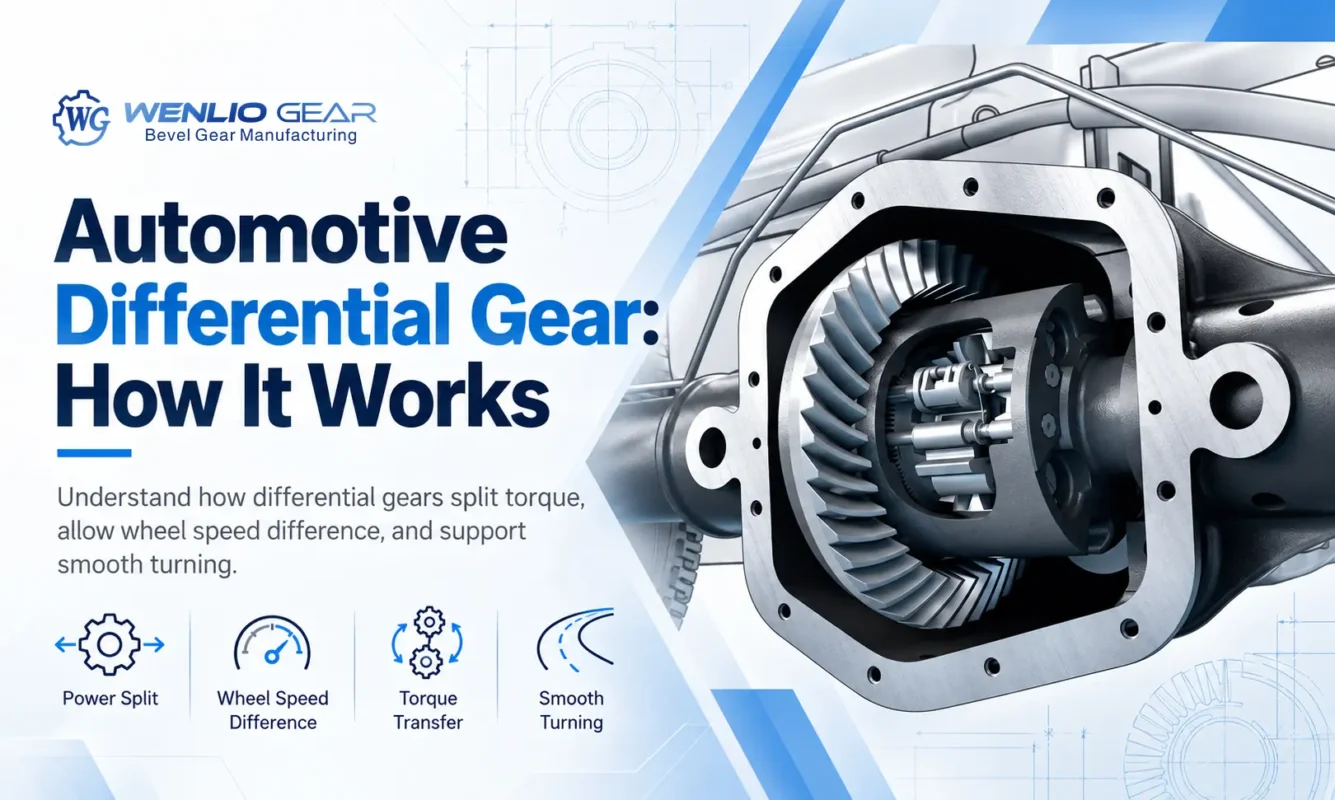
When a vehicle turns, the wheels on both sides naturally need to rotate at different speeds. The outer wheel travels a longer distance, while the inner wheel moves a shorter distance. An automotive differential gear system makes this possible by distributing power smoothly while allowing each wheel to rotate at the speed it needs.
For buyers sourcing differential gears, the challenge is not simply matching dimensions. A reliable differential gear set depends on many factors, including gear design, material performance, heat treatment, tooth contact, and inspection control. Wenlio works with customers to evaluate these requirements and provide customized precision bevel gears and transmission components for automotive and industrial applications.
What Is an Automotive Differential Gear
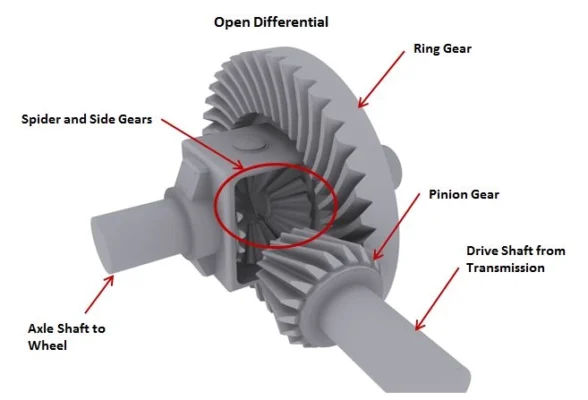
Automotive differential gear usually refers to the complete mechanism inside the differential housing. Layouts vary among drive systems, but the main mechanical parts have similar jobs.
| Component | Main function |
| Drive pinion | Receives torque and drives the ring gear |
| Ring gear | Turns the case and provides final reduction |
| Differential case | Supports the gears and rotates with the ring gear |
| Side gears | Connect to the left and right axle shafts |
| Spider gears | Rotate between the side gears to allow different wheel speeds |
Spider gears are also called differential pinion gears. They should not be confused with the drive pinion that meshes with the ring gear. Clear naming matters when drawings, samples, or inspection reports are exchanged between a buyer and a manufacturer.
How Does an Automotive Differential Gear Work
In a typical rear-drive axle, the driveshaft turns the drive pinion. The pinion turns the ring gear and differential case, while the side gears drive the axle shafts. A front-drive transaxle uses the same basic principle in a different layout.
Driving in a Straight Line
On a straight road, both wheels cover the same distance. The case, spider gears, and side gears rotate together, so both axle shafts turn at almost the same speed. In an open differential, each side receives equal torque, but usable torque is limited by the wheel with less grip.
Turning a Corner
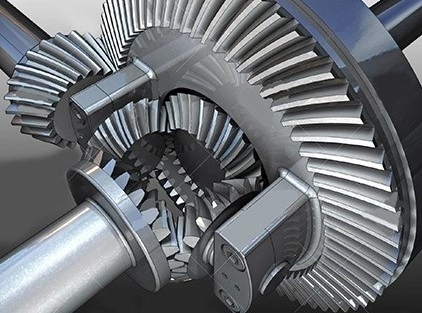
During a turn, resistance between the two sides makes the spider gears rotate on their shafts. One side gear speeds up as the other slows down. The average axle speed still follows the differential case, so power continues without forcing both wheels to rotate equally.
When One Wheel Loses Grip
On snow, mud, or uneven ground, a low-grip wheel can limit the torque available to the wheel with traction. Limited-slip, locking, and torque-vectoring systems address this weakness in different ways.
Common Types of Automotive Differentials
| Type | How it behaves | Typical use |
| Open | Allows free speed difference but has limited low-grip traction | Passenger vehicles |
| Limited-slip | Reduces excessive speed difference mechanically | Performance cars and light trucks |
| Locking | Links both axle shafts more firmly when needed | Off-road and heavy-duty vehicles |
| Torque vectoring | Varies wheel torque with controlled clutches or motors | Performance vehicles and EVs |
A software-controlled electronic differential in an EV may use separate motors rather than a conventional mechanical differential. Buyers should therefore confirm whether a project concerns a physical gear set, an electronically controlled mechanical unit, or a dual-motor drive system.
Why Hypoid Gears Are Common in Rear Axles
Many rear axles use a hypoid ring-and-pinion set. Its pinion is offset from the ring gear centerline, allowing a lower driveshaft position. Curved teeth engage gradually and can support high torque with smooth operation when geometry and mounting are correct.
The offset also creates more tooth-surface sliding, making lubrication, surface finish, and contact pattern critical. Greater offset may improve packaging and load capacity, but it can increase friction and heat. The design must balance strength, efficiency, noise, and space.
What Buyers Should Check Before Ordering
Diameter and tooth count do not fully define a differential gear. The manufacturer also needs geometry, operating conditions, and mounting data. Without them, a dimensionally correct ring-and-pinion set may still run loudly or wear unevenly.
| Check | Information to confirm | Why it matters |
| Geometry | Tooth count, ratio, module or DP, spiral hand, offset | Defines the mesh |
| Mounting | Mounting distance, bearings, backlash, alignment | Controls tooth contact |
| Duty | Torque, speed, shock load, duty cycle, target life | Guides strength checks |
| Material | Steel grade, certificates, permitted substitutes | Supports process control |
| Quality | Accuracy, hardness, case depth, finish, reports | Sets acceptance criteria |
If a complete drawing is unavailable, provide clear photos, a usable sample, the vehicle or axle application, and any original part information. A worn sample can help identify the design, but wear may have changed the tooth surface, backlash, and bearing seats. The supplier should separate original design features from damage instead of copying every measured condition.
Material and Heat Treatment
Differential gears carry repeated contact stress and bending loads. Carburizing steels such as SAE 8620, SAE 9310, and 18CrNiMo7-6 are often considered, but the correct grade depends on the design, load, and specification. Material chemistry and heat-treatment response also matter.
Carburizing and quenching produce a hard case over a tougher core. Buyers should approve surface hardness, effective case depth, core hardness, and metallurgical requirements. Because heat treatment can distort the gear, final geometry and contact should be checked after finishing.
Ring and Pinion Matching
A ring gear and drive pinion work as a pair. Each part may pass dimensional inspection, yet the set can still run noisily if mounting distance, backlash, or alignment is wrong. Matched-pair identification should keep the approved parts together through inspection, packing, and assembly.
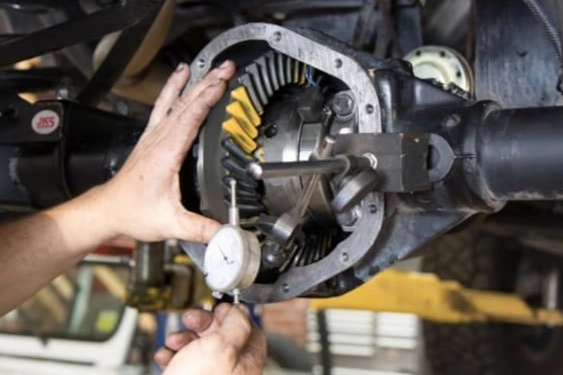
A contact-pattern check shows where the teeth carry load. A pattern near the toe, heel, root, or top land may indicate geometry or setup problems. It must be interpreted with the design, mounting data, and backlash.
Inspection That Reduces Assembly Risk
Inspection should cover the features that affect meshing. The plan may include profile and lead, pitch, runout, dimensions, surface roughness, hardness, case depth, material verification, crack inspection, and tooth contact. Agree on required reports before production.
A useful report shows the drawing revision, part number, lot reference, tolerance, actual result, and inspection status. This supports traceability from sample approval through later production.
How to Choose a Differential Gear Manufacturer
Choose a supplier that reviews the complete gear set rather than quoting from outside dimensions alone. Confirm the mating part, ratio, load, material, heat treatment, mounting conditions, and inspection plan. Validate samples before volume production.
Useful evidence includes gear measurements, contact-testing records, material certificates, heat-treatment results, and matched-pair control. Ask how drawing changes are approved and how inspection data is linked to each lot.
Why Choose us
Wenlio develops custom bevel, spiral bevel, hypoid, and related transmission components from drawings, samples, and application data. Project review can cover geometry, manufacturability, heat treatment, finishing, tooth contact, and inspection requirements before machining begins.
For a project review, send the drawings, target ratio, material and hardness, expected quantity, application details, and requested reports. If drawings are incomplete, sample photos and mounting information can guide the next checks.
FAQ
What does an automotive differential gear do
It divides torque between two axle shafts while allowing the left and right wheels to rotate at different speeds. This is essential when the vehicle turns because the outside wheel travels farther than the inside wheel.
What gears are used in a differential
The internal mechanism normally uses side gears and spider gears. The final drive may use spiral bevel or hypoid gears, depending on the axle or transaxle layout.
Why are ring and pinion gears supplied as a matched pair
Their tooth geometry, backlash, mounting distance, and contact pattern work together. Pair control reduces the risk of noise, uneven loading, and early wear after assembly.
Can a differential gear be reproduced from a sample
Often yes, but the sample must be evaluated for wear and damage. Application details and mounting data are still valuable because a worn tooth surface may no longer represent the original design.
What should be included in a differential gear inspection report
The report should cover the agreed characteristics, such as dimensions, gear accuracy, runout, hardness, case depth, and tooth contact. It should also identify the drawing revision and production lot.
Conclusion
An automotive differential gear lets the drive wheels follow different paths without interrupting torque delivery. Its performance depends on more than the visible gear dimensions. Ring-and-pinion geometry, mounting position, material, heat treatment, lubrication, and tooth contact must work as one system.
For buyers developing automotive differential gear projects, choosing the right supplier involves more than dimensions and quotations. Material selection, heat treatment, gear matching, and inspection capability are key to consistent performance. Wenlio provides customized precision bevel gears and transmission components based on drawings, samples, and application requirements. Contact Wenlio to discuss your differential gear project and send your requirements for a professional review.

Pingback: What Affects an E-Drive Bevel Gear Quote? - wenlio.com