Gear Guides/Materials and Heat Treatment

Material selection guide

How to Choose Gear Materials for Your Application

A gear material should suit the load, expected failure mode, operating environment, heat treatment, manufacturing route, and inspection plan. The grade name alone does not tell you whether a gear will work.

This guide compares common material families and shows what buyers should confirm before approving a drawing or quotation.

Discuss Your Gear Application View Custom Gear Capabilities

Quick answer

Specify the grade and its final condition

Start with the required tooth-root strength, contact durability, shock resistance, wear behavior, and dimensional stability. Then choose a material and heat-treatment route that can produce those properties in the actual gear size. Finish by defining hardness, case depth, core condition, allowable distortion, and inspection records on the drawing.

Before selecting a grade

Define what the gear must survive

Two gears with the same dimensions may need different materials because their loads, duty cycles, lubrication, environments, or manufacturing routes are different.

01

Load and life

State torque, speed, duty cycle, start-stop frequency, shock load, reversals, and expected service life. These inputs affect tooth-root and contact stress calculations.

Ask for: load spectrum and safety factors

02

Likely failure mode

Consider bending fatigue, pitting, scuffing, wear, plastic deformation, tooth breakage, and corrosion. One material route rarely has the same advantage against every failure mode.

Ask for: previous failure evidence

03

Operating environment

Temperature, lubricant, contamination, moisture, chemicals, food-contact rules, and electrical or magnetic requirements can remove otherwise suitable options.

Ask for: environment and lubricant data

04

Size and manufacturing route

Section thickness affects hardenability. Gear size, geometry, accuracy, quantity, stock allowance, and finishing access affect the practical route and total cost.

Ask for: final accuracy after heat treat

Material family comparison

Match the material family to the duty

Use the table as a screening tool. The final grade, quality level, cleanliness, heat treatment, hardness, case depth, and test method should follow the drawing and the applicable rating standard.

Material family Where it often fits Main benefit Watch point
Medium-carbon steel1045, C45, S45C Moderate-duty gears, large gears, repair parts, and economical drives. Readily available and suitable for normalized, quenched-and-tempered, or induction-hardened routes. Hardenability and core properties become more important as section size increases.
Through-hardening alloy steel4140, 42CrMo4, related grades Gear shafts, industrial gears, and parts that need strength through the section. Useful balance of strength, toughness, and machinability after controlled heat treatment. Surface durability may be lower than a suitable case-hardened route for severe contact duty.
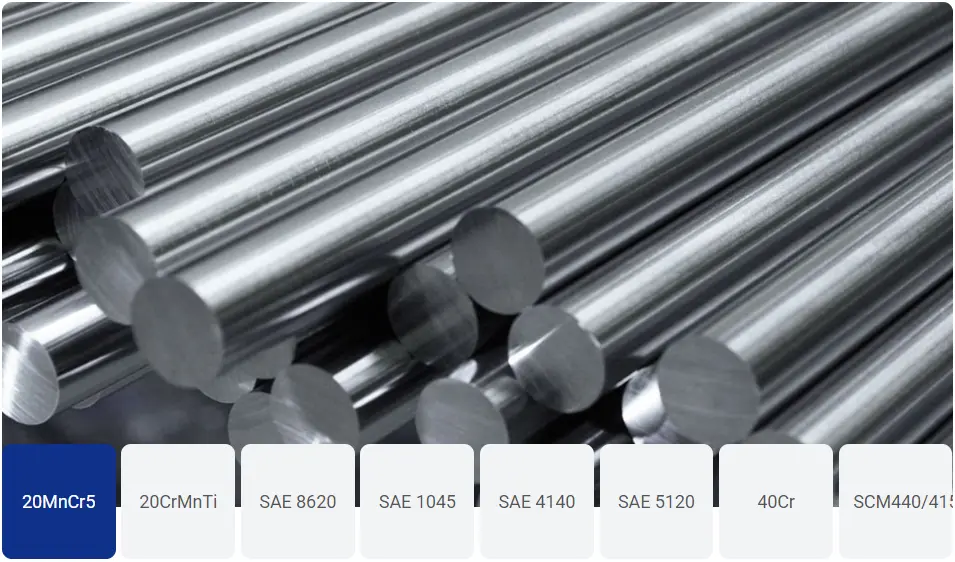
Carburizing steel8620, 20MnCr5, 20CrMnTi, 18CrNiMo7-6 High-load transmission gears that need a hard wear surface and tougher core. Deep load-carrying case can support demanding contact and bending duty when correctly specified. Quenching can distort the part. Allowance, fixturing, and post-heat-treatment finishing need planning.
Nitriding-capable steelGrade depends on process and specification Precision gears where a hard surface and lower heat-treatment distortion are important. Hard surface without a conventional quench after nitriding. The hardened layer is usually shallower than a carburized case and the cycle can be long.
Stainless steel420, 17-4PH, 304 or 316 where suitable Wet, washdown, corrosive, or clean-service equipment. Corrosion behavior may reduce reliance on protective coatings. Strength, hardness, galling, machinability, and corrosion resistance vary widely by grade and condition.
Bronze and copper alloysCommon in worm wheels Sliding-contact pairs, especially worm gear sets matched with a suitable steel worm. Compatibility, conformability, and anti-seizure behavior can suit high sliding contact. Alloy, lubricant, temperature, load, and mating material must be considered as a system.
Engineering plasticsAcetal, nylon, and related materials Light-duty drives that value low mass, corrosion resistance, or lower noise. Can run quietly and may reduce lubrication needs in suitable applications. Creep, moisture absorption, temperature, wear, dimensional change, and lower stiffness limit use.
Engineering reference: ISO 6336-5 addresses material quality and heat-treatment effects within gear load-capacity calculations. The selected grade should be tied to the rating method, drawing, and agreed inspection requirements.
Gear-Material-Selection

A useful drawing states more than a grade

Material + condition + verification

For example, a grade designation without heat-treatment condition, hardness range, case-depth definition, and required certification leaves room for different interpretations.

Materials for Bevel Gears

Material and heat treatment

Treat them as one decision

A material grade has a range of possible properties. Heat treatment determines the condition delivered to the finished gear, while the section size, prior microstructure, quench method, and finishing route affect the result.

Do not copy a hardness value or case depth from another gear without checking tooth size, load, service life, grinding allowance, and distortion risk.

View Gear Heat Treatment

01

Carburize and quench

Used with suitable low-carbon alloy steels when the design needs a hard case and tougher core. Plan for distortion, retained stock, and hard finishing.

02

Quench and temper

Builds strength and toughness through the section. It can be the final condition or a preparation step before another surface treatment.

03

Induction hardening

Hardens selected tooth areas on a responsive steel. Coil design, frequency, heating pattern, root coverage, and tempering require process control.

04

Nitriding

Produces a hard surface at a lower process temperature than carburizing and quenching. Material condition and compound-layer requirements still need definition.

Practical decision paths

Start with the application, then narrow the options

These are starting points for an engineering review, not substitute specifications. Rating calculations, drawings, standards, and validation tests govern the final choice.

High-load gearbox

Surface durability and core support

Review case-carburizing steels when high contact load, repeated bending, compact size, and long life point toward a hard case with a tougher core.

Also checkDistortion, grinding stock, case depth

Large industrial gear

Section properties and practical heat treatment

Quenched-and-tempered alloy steel, medium-carbon steel, cast steel, or ductile iron may be considered according to size, load, duty, manufacturing route, and repair needs.

Also checkHardenability, forging or casting quality

Precision low-distortion gear

Stable geometry after treatment

A nitrided route may suit a gear that needs a hard surface with limited heat-treatment movement, provided the available case and core properties support the load.

Also checkCase thickness, edge condition, cycle time

Corrosive or washdown service

Corrosion resistance with mechanical limits

Compare stainless grades with coated or protected alloy steels. The environment may favor stainless steel, but load capacity and galling behavior still need review.

Also checkChemicals, cleaning, passivation, lubrication

Worm gear set

Choose the mating pair together

A hardened steel worm and a suitable bronze wheel are common because the pair must manage sliding contact, friction, heat, lubrication, and wear together.

Also checkBronze alloy, speed, oil, temperature

Quiet light-duty drive

Lower mass and noise

An engineering plastic gear or a metal-plastic pair may fit modest loads. Verify temperature, moisture, creep, tooth deflection, wear, and dimensional tolerance.

Also checkDuty cycle, humidity, lubrication

Drawing and RFQ

Specify the result you need to receive

Cross-standard grade names are not automatically interchangeable. Chemical ranges, hardenability, product form, cleanliness, supply condition, and heat-treatment response may differ.

If alternative grades are allowed, state who can approve the substitution and which mechanical, metallurgical, dimensional, and documentation requirements must remain unchanged.

Custom Gears Made to Drawing or Sample

Material requirement checklist

01

Material identityStandard, grade, product form, delivery condition, and permitted equivalents.

02

Heat-treatment conditionProcess route, surface hardness, core hardness, and any pre-machining condition.

03

Case requirementsEffective or total case depth, measurement method, test location, and acceptable range where applicable.

04

Metallurgical limitsMicrostructure, decarburization, retained austenite, carbide condition, grain flow, or cleanliness when the application requires them.

05

Dimensional conditionWhich dimensions and gear accuracy requirements apply after heat treatment and final finishing.

06

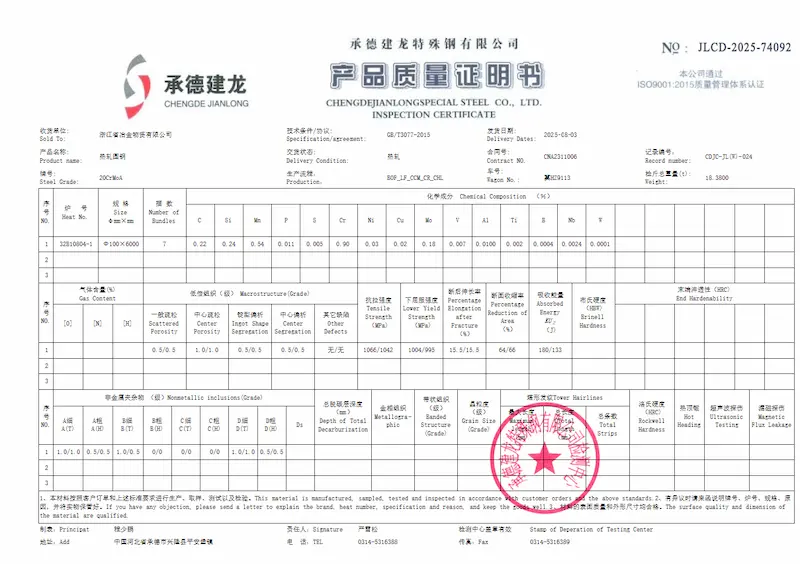
Required evidenceMill certificate, hardness report, case-depth result, metallographic report, FAI, or PPAP as agreed.

Wenlio Material Certification Report

Example material documentation. The required certificate type and traceability level should be agreed before production.

Verification

Confirm the material condition, not just the label

A certificate identifies the supplied material and reported chemistry or properties. It does not replace checks on the finished gear after heat treatment.

CERT

Material traceability

Link the material certificate, heat number, and part records when the project requires traceability.

HARD

Hardness testing

Define the scale, location, preparation, and acceptance range for surface and core checks.

CASE

Case-depth verification

State the definition and method so the supplier and buyer calculate the same result.

GEOM

Final geometry

Measure the dimensions and tooth characteristics required after heat treatment and finishing.

View Quality Control and Inspection

Buyer questions

Gear material FAQ

Short answers to questions that often appear during drawing review and supplier discussions.

There is no single best material. The choice depends on tooth-root stress, contact stress, shock load, speed, lubrication, environment, gear size, life target, heat treatment, accuracy, and cost.

No. Alloy steel can provide higher hardenability, strength, or toughness, but carbon steel may be adequate and more economical for moderate loads, large gears, repair parts, or induction-hardened applications.

A suitable carburizing steel can develop a hard wear-resistant case with a tougher core. This combination can support high contact duty and repeated tooth loading, but the process needs distortion and finishing control.

Some stainless grades and heat-treated conditions can carry meaningful loads, but stainless steels vary widely. The grade must be checked for strength, hardness, corrosion resistance, galling, machinability, and operating environment.

Depending on the project, buyers may request a mill certificate, heat-treatment record, surface and core hardness results, case-depth report, metallographic results, dimensional report, and gear inspection report.

Material and process review

Need to compare material options for a custom gear?

Send the drawing, load and speed data, duty cycle, environment, lubrication, life target, accuracy, quantity, and required reports. Wenlio can review the material, heat treatment, manufacturing route, and inspection plan before quotation.